
Ch 44: Particle Physics and Cosmology
Young & Freedman Calc - University Physics 14th Edition
Young & Freedman Calc14th EditionUniversity PhysicsISBN: 9780321973610당신이 사용하는 게 아니라요?교과서 변경
44장, 문제 18

How much energy is released when a µµ^- muon at rest decays into an electron and two neutrinos? Neglect the small masses of the neutrinos.

검증된 단계별 안내
1
Identify the particles involved in the decay: a muon (µ⁻) at rest decays into an electron (e⁻) and two neutrinos. Since the neutrinos have negligible mass, their rest mass energy can be ignored.
Recall that the energy released in the decay comes from the difference in rest mass energies between the initial particle and the final particles. The muon has a rest mass energy of \(m_\mu c^2\), and the electron has a rest mass energy of \(m_e c^2\).
Write the expression for the energy released (Q-value) as the difference between the initial and final rest mass energies: \(Q = (m_\mu - m_e) c^2\)
Look up or recall the rest masses of the muon and electron (in kilograms or atomic mass units) and the speed of light \(c\) (approximately \(3 \times 10^8\) m/s) to use in the calculation.
Substitute the values into the equation and calculate the energy released, remembering to keep the units consistent (e.g., joules or electronvolts).

비슷한 문제에 대한 검증된 영상 답변:

이 영상 해법은 위 문제에 도움이 된다고 튜터들이 추천한 것입니다.
영상 길이:
1m
도움이 되었나요?

주요 개념

질문에 올바르게 답하기 위해 반드시 이해해야 하는 핵심 개념들은 다음과 같습니다.

Muon Decay and Particle Rest Mass

Muon decay is a weak interaction process where a muon at rest transforms into an electron and two neutrinos. The muon’s rest mass energy is converted into the kinetic energy of the decay products. Understanding the rest mass energies of the particles involved is essential to calculate the energy released.
추천 영상:
가이드 코스
04:32
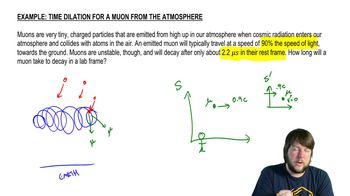
Time Dilation for a Muon from the Atmosphere

Conservation of Energy in Particle Decay

In particle decay, the total energy before and after the decay must be conserved. The initial rest mass energy of the muon equals the sum of the kinetic energies and rest mass energies of the decay products. Neglecting neutrino masses simplifies the calculation by focusing on the electron’s rest mass and kinetic energy.
추천 영상:
가이드 코스
06:24
Conservation Of Mechanical Energy

Mass-Energy Equivalence (E=mc²)

Mass-energy equivalence states that mass can be converted into energy and vice versa, as described by Einstein’s equation E=mc². The difference in rest mass between the initial muon and the final electron corresponds to the energy released during decay, primarily carried away as kinetic energy of the decay products.
추천 영상:
가이드 코스
4:52
Gravitational Potential Energy for Systems of Masses
관련 실천
교과서 질문

In Example 44.344.3, it was shown that a proton beam with an 800800-GeV beam energy gives an available energy of 38.738.7 GeV for collisions with a stationary proton target. In a colliding-beam experiment, what total energy of each beam is needed to give an available energy of 2(38.72(38.7 GeV)=77.4) = 77.4 GeV?

1687
views
교과서 질문

You work for a start-up company that is planning to use antiproton annihilation to produce radioactive isotopes for medical applications. One way to produce antiprotons is by the reaction p+pp+p+p+pˉp + p → p + p + p + p̄ in proton-proton collisions. You first consider a colliding-beam experiment in which the two proton beams have equal kinetic energies. To produce an antiproton via this reaction, what is the required minimum kinetic energy of the protons in each beam?

1301
views
교과서 질문

A K+K^+ meson at rest decays into two pp mesons. What are the allowed combinations of π0π^0 , π+π^+, and ππ^- as decay products?

1382
views
교과서 질문

Table 44.344.3 shows that a Σ0Σ^0 decays into a Λ0Λ^0 and a photon. What is the magnitude of the momentum of the photon? Is it reasonable to ignore the final momentum and kinetic energy of the Λ0Λ^0? Explain.

1312
views
교과서 질문

If a Σ+Σ^+ at rest decays into a proton and a π0π^0, what is the total kinetic energy of the decay products?

1305
views
교과서 질문

Table 44.344.3 shows that a Σ0Σ^0 decays into a Λ0Λ^0 and a photon. Calculate the energy of the photon emitted in this decay, if the Λ0Λ^0 is at rest.

1237
views