Ch 44: Particle Physics and Cosmology
Young & Freedman Calc - University Physics 14th Edition
Young & Freedman Calc14th EditionUniversity PhysicsISBN: 9780321973610당신이 사용하는 게 아니라요?교과서 변경
44장, 문제 15b

In Example 44.344.3, it was shown that a proton beam with an 800800-GeV beam energy gives an available energy of 38.738.7 GeV for collisions with a stationary proton target. In a colliding-beam experiment, what total energy of each beam is needed to give an available energy of 2(38.72(38.7 GeV)=77.4) = 77.4 GeV?

검증된 단계별 안내
1
Start by understanding the concept of available energy in particle collisions. In a stationary target experiment, the available energy is limited by the energy of the moving particle and the rest energy of the stationary particle. However, in a colliding-beam experiment, the available energy depends on the total energy of both beams and is more efficient for high-energy collisions.
The formula for the available energy \( E_{\text{available}} \) in a colliding-beam experiment is given by: \( E_{\text{available}} = \sqrt{2E_1E_2 + 2m^2c^4} \), where \( E_1 \) and \( E_2 \) are the total energies of the two beams, and \( m \) is the rest mass of the proton.
In this problem, the two beams are identical, so \( E_1 = E_2 = E \). Substituting this into the formula simplifies it to: \( E_{\text{available}} = \sqrt{4E^2 - 4m^2c^4} \).
Rearrange the equation to solve for \( E \), the total energy of each beam. Start by squaring both sides: \( E_{\text{available}}^2 = 4E^2 - 4m^2c^4 \). Then isolate \( E^2 \): \( E^2 = \frac{E_{\text{available}}^2 + 4m^2c^4}{4} \).
Substitute the given values: \( E_{\text{available}} = 77.4 \ \text{GeV} \) and \( mc^2 = 0.938 \ \text{GeV} \) (rest energy of a proton). Use these to calculate \( E \), the total energy of each beam, by plugging them into the equation: \( E = \sqrt{\frac{(77.4)^2 + 4(0.938)^2}{4}} \).

비슷한 문제에 대한 검증된 영상 답변:

이 영상 해법은 위 문제에 도움이 된다고 튜터들이 추천한 것입니다.
영상 길이:
1m
도움이 되었나요?

주요 개념

질문에 올바르게 답하기 위해 반드시 이해해야 하는 핵심 개념들은 다음과 같습니다.

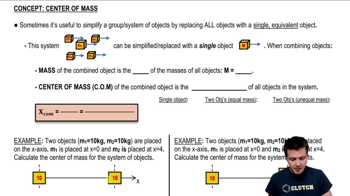
Center of Mass Energy

Center of mass energy is the total energy available for particle interactions in the center of mass frame. It is crucial in high-energy physics as it determines the energy available for creating new particles during collisions. In colliding beam experiments, the center of mass energy is calculated based on the energies of the colliding particles, which can be different if one is stationary.
추천 영상:
가이드 코스
06:30
Intro to Center of Mass

Relativistic Energy-Momentum Relation

The relativistic energy-momentum relation describes how energy and momentum are related in relativistic physics. It states that the total energy (E) of a particle is equal to its rest mass energy plus its kinetic energy, which is influenced by its momentum. This relationship is essential for calculating the energies required in high-energy collisions, especially when dealing with particles moving at speeds close to the speed of light.
추천 영상:
가이드 코스
05:17
Intro to Momentum

Beam Energy and Collision Dynamics

Beam energy refers to the energy of particles in a beam before they collide. In colliding beam experiments, the dynamics of the collision depend on the energies of both beams. To achieve a specific available energy for particle interactions, the total energy of each beam must be calculated, taking into account the rest mass of the particles involved and the desired center of mass energy.
추천 영상:
가이드 코스
09:25
Collision Problems with Motion/Energy