Calculate the minimum beam energy in a proton-proton collider to initiate the reaction. The rest energy of the is MeV (see Table ).
Ch 44: Particle Physics and Cosmology
44장, 문제 16a
You work for a start-up company that is planning to use antiproton annihilation to produce radioactive isotopes for medical applications. One way to produce antiprotons is by the reaction in proton-proton collisions. You first consider a colliding-beam experiment in which the two proton beams have equal kinetic energies. To produce an antiproton via this reaction, what is the required minimum kinetic energy of the protons in each beam?
검증된 단계별 안내1
Step 1: Understand the reaction. The given reaction is p + p → p + p + p + p̄, where two protons collide to produce two protons, one additional proton, and one antiproton. The goal is to determine the minimum kinetic energy required for this reaction to occur.
Step 2: Apply the principle of energy conservation. The total energy of the system before and after the collision must be conserved. The initial energy includes the rest energy and kinetic energy of the two protons. The final energy includes the rest energy of the three protons and one antiproton, plus any kinetic energy of the products.
Step 3: Calculate the rest energy of the particles. The rest energy of a proton is given by E₀ = mₚc², where mₚ is the mass of the proton and c is the speed of light. Similarly, the rest energy of an antiproton is the same as that of a proton because they have equal masses. Therefore, the total rest energy of the products is 3mₚc² (for three protons) + mₚc² (for one antiproton) = 4mₚc².
Step 4: Determine the minimum kinetic energy required. In a colliding-beam experiment, the two protons have equal kinetic energies. To produce the antiproton, the total energy of the system must be at least equal to the total rest energy of the products (4mₚc²). Since the initial system consists of two protons, their combined rest energy is 2mₚc². The additional energy required to reach 4mₚc² must come from the kinetic energy of the protons. Therefore, the minimum kinetic energy of each proton is (4mₚc² - 2mₚc²) / 2 = mₚc².
Step 5: Conclude the solution. The minimum kinetic energy of each proton in the colliding-beam experiment is equal to the rest energy of a single proton, mₚc². This ensures that the total energy of the system is sufficient to produce the antiproton and satisfy energy conservation.

비슷한 문제에 대한 검증된 영상 답변:
이 영상 해법은 위 문제에 도움이 된다고 튜터들이 추천한 것입니다.
영상 길이:
2m도움이 되었나요?
주요 개념
질문에 올바르게 답하기 위해 반드시 이해해야 하는 핵심 개념들은 다음과 같습니다.
Energy-Mass Equivalence
Energy-mass equivalence, expressed by Einstein's equation E=mc², indicates that mass can be converted into energy and vice versa. In particle physics, this principle is crucial for understanding how kinetic energy from colliding particles can create new particles, such as antiprotons, during high-energy collisions.
추천 영상:
가이드 코스
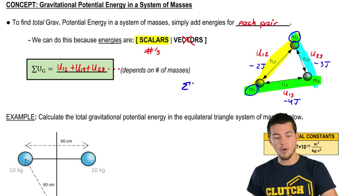
Gravitational Potential Energy for Systems of Masses
Threshold Energy
Threshold energy is the minimum energy required for a reaction to occur. In the context of proton-proton collisions, it refers to the kinetic energy needed for the protons to produce an antiproton. This energy must account for the rest mass energy of the produced particles, ensuring that the collision has sufficient energy to create the additional mass.
추천 영상:
가이드 코스
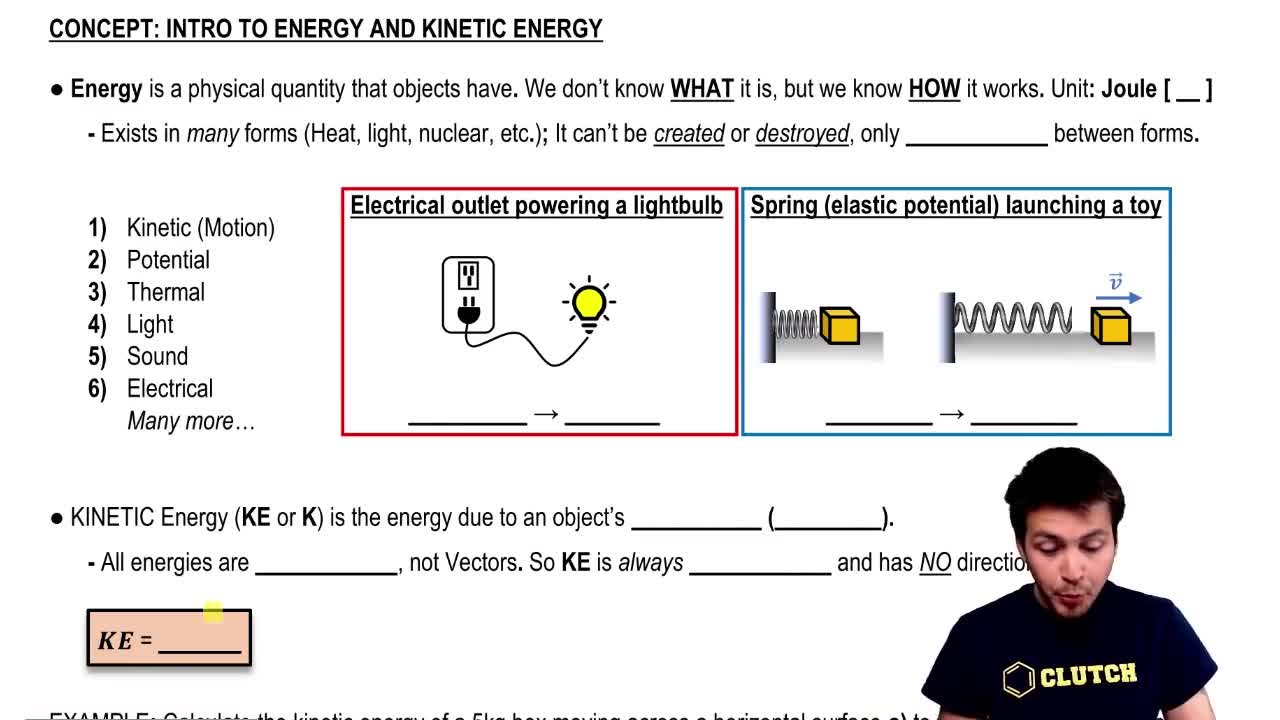
Intro to Energy & Types of Energy
Conservation of Energy and Momentum
The conservation of energy and momentum principles state that in an isolated system, the total energy and momentum before a reaction must equal the total energy and momentum after the reaction. In the case of proton collisions, this means that the kinetic energy of the colliding protons must be sufficient to not only create the antiproton but also conserve the overall momentum of the system.
추천 영상:
가이드 코스
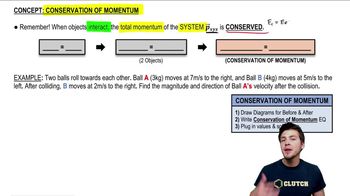
Conservation Of Momentum
관련 실천
교과서 질문
1455
views
교과서 질문
In Example , it was shown that a proton beam with an -GeV beam energy gives an available energy of GeV for collisions with a stationary proton target. In a colliding-beam experiment, what total energy of each beam is needed to give an available energy of GeV GeV?
1687
views
교과서 질문
How much energy is released when a muon at rest decays into an electron and two neutrinos? Neglect the small masses of the neutrinos.
1500
views
교과서 질문
A meson at rest decays into two mesons. What are the allowed combinations of , , and as decay products?
1382
views
교과서 질문
What is the speed of a proton that has total energy GeV?
2146
views
교과서 질문
Table shows that a decays into a and a photon. Calculate the energy of the photon emitted in this decay, if the is at rest.
1237
views