 Back
Liberal Arts Math Exam 3 Study Guide: Probability, Counting, and Combinatorics
Study Guide - Smart Notes
 Tailored notes based on your materials, expanded with key definitions, examples, and context.
Q1. In how many different ways can a new car be ordered given 8 possible colors and 5 binary options (air conditioning, heated seats, anti-lock brakes, power windows, CD player)?
Background
Topic: Counting Principles (Multiplication Principle)
This question tests your understanding of how to count the total number of possible outcomes when making independent choices for each feature of a product.
Key Terms and Formulas
Multiplication Principle: If there are ways to do one thing and ways to do another, there are ways to do both.
Binary Option: A choice with two possibilities (e.g., with or without a feature).
Step-by-Step Guidance
Identify the number of choices for each feature: 8 colors, and each of the 5 features has 2 options (with or without).
Use the multiplication principle to combine the choices: Multiply the number of options for each feature together.
Set up the expression:
Simplify the powers of 2:
Try solving on your own before revealing the answer!
Final Answer: 256 different ways
There are possible ways to order the car with these options.
Q2a. Evaluate the factorial expression:
Background
Topic: Factorials and Simplification
This question tests your ability to simplify expressions involving factorials.
Key Terms and Formulas
Factorial (): The product of all positive integers up to .
Factorial Division:
Step-by-Step Guidance
Write out the definition of and .
Notice that .
Substitute this into the expression and cancel from numerator and denominator.
Try solving on your own before revealing the answer!
Final Answer: 103,362
Q2b. Evaluate the expression:
Background
Topic: Combinations
This question tests your ability to compute the number of ways to choose items from without regard to order.
Key Terms and Formulas
Combination Formula:
Step-by-Step Guidance
Identify and .
Plug these values into the combination formula.
Set up the factorials:
Try solving on your own before revealing the answer!
Final Answer: 116,280
Q3. A bell tower has 12 bells, each with a different note. 6 bells are rung in sequence, no bell more than once. How many unique sequences are there?
Background
Topic: Permutations
This question tests your understanding of how to count the number of ways to arrange a subset of items in order.
Key Terms and Formulas
Permutation Formula:
Step-by-Step Guidance
Identify (bells) and (bells to be rung).
Plug these values into the permutation formula.
Set up the expression:
Try solving on your own before revealing the answer!
Final Answer: 665,280
There are unique sequences.
Q4. To win at LOTTO, select 5 numbers from 50 (order does not matter). How many different selections are possible?
Background
Topic: Combinations
This question tests your ability to count the number of ways to choose a subset of items when order does not matter.
Key Terms and Formulas
Combination Formula:
Step-by-Step Guidance
Identify and .
Plug these values into the combination formula.
Set up the expression:
Try solving on your own before revealing the answer!
Final Answer: 2,118,760
There are possible selections.
Q5. Suppose a fair, six-sided die is rolled. Find the probability of:
a) Rolling a prime number.
Background
Topic: Basic Probability
This question tests your ability to count favorable outcomes and calculate probability.
Key Terms and Formulas
Probability:
Step-by-Step Guidance
List the numbers on a die: 1, 2, 3, 4, 5, 6.
Identify which are prime: 2, 3, 5.
Count the number of favorable outcomes (prime numbers).
Set up the probability formula with the number of favorable and total outcomes.
Try solving on your own before revealing the answer!
Final Answer:
There are 3 prime numbers out of 6, so .
b) Rolling a number more than 4.
Background
Topic: Basic Probability
This question tests your ability to count outcomes greater than a given value.
Key Terms and Formulas
Probability formula as above.
Step-by-Step Guidance
List numbers greater than 4: 5, 6.
Count the number of favorable outcomes.
Set up the probability formula.
Try solving on your own before revealing the answer!
Final Answer:
There are 2 numbers greater than 4 out of 6, so .
Q6. In roulette, betting $10 on red (18 red, 18 black, 2 neither). If you win, you keep your $10 and win $10. If not, you lose your $10. What is the expected value for playing?
Background
Topic: Expected Value in Probability
This question tests your ability to calculate expected value based on possible outcomes and their probabilities.
Key Terms and Formulas
Expected Value:
Step-by-Step Guidance
Calculate the probability of winning (landing on red): .
Calculate the probability of losing (landing on black or neither): .
Determine the net gain/loss for each outcome: win = +$10, lose = -$10.
Set up the expected value formula using these probabilities and outcomes.
Try solving on your own before revealing the answer!
Final Answer: -$0.53
The expected value is negative, meaning you lose about 53 cents per $10 bet on average.
Q7. A box contains 40 widgets, 5 defective. If 5 are sold at random, find the probability that:
a) All are defective.
Background
Topic: Probability with Combinations (Hypergeometric Probability)
This question tests your ability to calculate probabilities when sampling without replacement.
Key Terms and Formulas
Hypergeometric Probability:
Step-by-Step Guidance
Identify (total), (defective), (chosen), (all defective).
Plug values into the formula:
Try solving on your own before revealing the answer!
Final Answer: 1 in 658,008
The probability is , a very rare event.
b) None are defective.
Background
Same as above, but .
Step-by-Step Guidance
Plug values into the formula:
Try solving on your own before revealing the answer!
Final Answer: 0.237
The probability is about 23.7% that none are defective.
Q8. Use the table of movers in Country X to find probabilities:
a) Probability a randomly selected mover was an owner.
Background
Topic: Probability from Contingency Tables
This question tests your ability to use data tables to find probabilities.
Key Terms and Formulas
Probability:
Step-by-Step Guidance
Find the total number of owners who moved (sum across all columns for owners).
Find the total number of people who moved (sum all entries).
Set up the probability formula.
Try solving on your own before revealing the answer!
Final Answer: 0.386
Probability is .
b) Probability a mover was a renter or moved to a different continent.
Background
Topic: Probability with "or" (Union of Events)
Key Terms and Formulas
Union Formula:
Step-by-Step Guidance
Find the total number of renters and the total who moved to a different continent.
Find the overlap (renters who moved to a different continent).
Apply the union formula and divide by the total.
Try solving on your own before revealing the answer!
Final Answer: 0.645
Probability is .
c) Probability a mover was an owner given they moved to a different country on the same continent.
Background
Topic: Conditional Probability
Key Terms and Formulas
Conditional Probability:
Step-by-Step Guidance
Find the number of owners who moved to a different country on the same continent.
Find the total number who moved to a different country on the same continent.
Set up the conditional probability formula.
Try solving on your own before revealing the answer!
Final Answer: 0.383
Probability is .
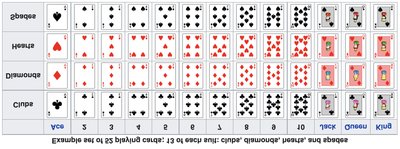
Q9. Suppose you draw one card from a 52-card deck. Find the probability that:
a) It is not a face card.
Background
Topic: Probability with Playing Cards
This question tests your knowledge of the composition of a standard deck and basic probability.
Key Terms and Formulas
Face cards: Jack, Queen, King (3 per suit, 12 total).
Probability formula as above.
Step-by-Step Guidance
Calculate the number of non-face cards: 52 total - 12 face cards.
Set up the probability formula.
Try solving on your own before revealing the answer!
Final Answer:
There are 40 non-face cards in a deck of 52.
b) It is either a club or a black card.
Background
Topic: Probability with Overlapping Events
Key Terms and Formulas
Clubs: 13 cards, all black.
Black cards: 26 cards (clubs + spades).
Union formula as above.
Step-by-Step Guidance
Count the number of clubs (13) and black cards (26).
Notice that all clubs are black, so the overlap is 13.
Apply the union formula: .
Try solving on your own before revealing the answer!
Final Answer:
All clubs are black, so the probability is .
Q10. The winner of a raffle will receive a new car. If 25,000 tickets were sold and you purchased 20, what are the odds against your winning?
Background
Topic: Odds in Probability
This question tests your understanding of how to calculate odds against an event.
Key Terms and Formulas
Odds against:
Step-by-Step Guidance
Calculate the number of ways to win (tickets you have).
Calculate the number of ways to lose (total tickets - your tickets).
Set up the odds against formula.
Try solving on your own before revealing the answer!
Final Answer: 1,249 to 1
Odds against winning are to 1.
Q11. There are 38 chocolates: 12 with nuts, 12 with caramel, 14 solid. You select one, eat it, then select a second. Find the probability both are solid chocolate.
Background
Topic: Probability without Replacement
This question tests your ability to calculate probabilities when the sample size decreases after each selection.
Key Terms and Formulas
Probability without replacement:
Step-by-Step Guidance
Find the probability the first chocolate is solid: .
After eating one, there are 13 solid left and 37 total.
Find the probability the second is solid: .
Multiply the two probabilities together.
Try solving on your own before revealing the answer!
Final Answer: 0.132
The probability is .
Q12. An unfair coin is flipped repeatedly. The probability of heads is 0.48.
a) Probability of heads two flips in a row.
Background
Topic: Probability of Independent Events
This question tests your ability to multiply probabilities for independent events.
Key Terms and Formulas
Independent Events:
Step-by-Step Guidance
Probability of heads on one flip is 0.48.
Multiply the probability for two flips: .
Try solving on your own before revealing the answer!
Final Answer: 0.2304
Probability is .
b) Probability of tails four flips in a row.
Background
Probability of tails is .
Step-by-Step Guidance
Probability of tails on one flip is 0.52.
Multiply for four flips: .
Try solving on your own before revealing the answer!
Final Answer: 0.073
Probability is .
c) Probability of a tail at least once in ten flips.
Background
Topic: Complement Rule
Key Terms and Formulas
Complement Rule:
Step-by-Step Guidance
Probability of heads on one flip is 0.48.
Probability of all heads in 10 flips: .
Subtract this from 1 to get the probability of at least one tail.
Try solving on your own before revealing the answer!
Final Answer: 0.999
Probability is .
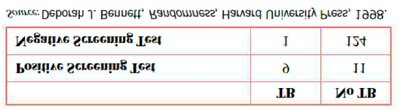
Q13. The data in the table are based on 145 Americans tested for tuberculosis (TB). Use the data to find the following probabilities:
a) Probability a randomly selected person has TB.
Background
Topic: Probability from Contingency Tables
Key Terms and Formulas
Probability:
Step-by-Step Guidance
Find the total number of people with TB (sum across the TB row).
Find the total number of people tested.
Set up the probability formula.
Try solving on your own before revealing the answer!
Final Answer: 0.069
Probability is .
b) Suppose a person has a positive test screening. Find the probability they have TB.
Background
Topic: Conditional Probability
Key Terms and Formulas
Conditional Probability:
Step-by-Step Guidance
Find the number of people with TB and a positive test.
Find the total number of people with a positive test.
Set up the conditional probability formula.
Try solving on your own before revealing the answer!
Final Answer: 0.5
Probability is .
