 Back
Odds and Probability: Quantitative Reasoning Study Notes
Study Guide - Smart Notes
 Tailored notes based on your materials, expanded with key definitions, examples, and context.
Odds and Probability
Introduction to Odds
Understanding odds is a fundamental concept in probability and statistics, which are core topics in Liberal Arts Math. Odds provide a way to express the likelihood of an event occurring compared to it not occurring. This section covers definitions, formulas, and applications of odds in various contexts.
Definition of Odds
Odds in Favor of an Event: The ratio of the probability that an event occurs to the probability that it does not occur.
Odds Against an Event: The ratio of the probability that an event does not occur to the probability that it does occur.
Formula for Odds in Favor:
Formula for Odds Against:
Expressing Odds as Ratios
Odds are often expressed as ratios in the form a : b, where a represents the number of favorable outcomes and b represents the number of unfavorable outcomes.
For example, if the probability of an event is , then the odds in favor are .
Calculating Odds from Probability
To convert probability to odds, use the following steps:
Find the probability of the event occurring, .
Find the probability of the event not occurring, .
Express the odds in favor as .
Example: If , then , so the odds in favor are .
Calculating Probability from Odds
To find the probability of an event given the odds in favor a : b:
Example: If the odds in favor are , then .
Applications of Odds
Odds are used in various real-world contexts, such as games of chance, sports, and risk assessment. Understanding how to calculate and interpret odds is essential for making informed decisions based on probability.
Worked Examples
Example 1: If the probability of drawing a red card from a standard deck is , the odds in favor are or .
Example 2: If the odds against an event are , then .
Visual Representation of Odds
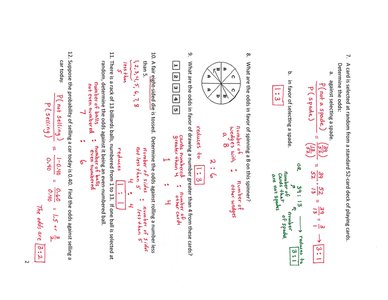
Visual aids such as spinners and dice can help illustrate the concept of odds and probability. For example, a spinner divided into equal sections can show the likelihood of landing on a particular color or number.
Summary Table: Odds and Probability Relationships
Type | Formula | Example |
|---|---|---|
Odds in Favor | Probability , Odds in favor | |
Odds Against | Probability , Odds against | |
Probability from Odds | Odds in favor , Probability |
Additional info:
These notes expand on the brief points in the original materials, providing full academic explanations, formulas, and examples. The spinner image is included as it directly illustrates the concept of probability and odds in a visual context.
