 Back
Study Guide: Sets and Set Operations in Liberal Arts Mathematics
Study Guide - Smart Notes
 Tailored notes based on your materials, expanded with key definitions, examples, and context.
Sets
Basic Set Concepts & Notation
In mathematics, a set is a collection of distinct objects, called elements. Sets are fundamental to understanding mathematical structure and relationships. The notation x ∈ A means "x is an element of set A."
Element Of (∈): An object is an element of a set if it belongs to that set. Example: 2 ∈ {1, 2, 3, 4}.
Empty Set (∅, {}): The set containing no elements. Example: The set of numbers greater than 20 and less than 10 is empty.
Universal Set (U): The set of all elements relevant to a particular situation. Example: If A is the set of land animals and B is the set of water animals, U is the set of all animals.
Subset (⊆): Set B is a subset of set A if every element of B is also in A. Example: {1, 2} ⊆ {1, 2, 3, 4}.
Proper Subset (⊂): A proper subset is any subset of A that is not equal to A itself. Example: {1, 2} ⊂ {1, 2, 3, 4}.
Complement (A'): The complement of set A is the set of all elements in the universal set U that are not in A.
Intersection (∩): The intersection of sets A and B is the set of elements common to both. Example: {2, 4} ∩ {4, 6} = {4}.
Union (∪): The union of sets A and B is the set of all elements in either A or B (or both).
Well-Defined Sets
A set is well-defined if its elements can be clearly determined and are not subjective. For example, the set of positive numbers is well-defined, but the set of the "prettiest colors" is not.
Roster Method
The roster method is a way to represent sets by listing their elements within braces. For example, A = {2, 4, 6, 8, ..., 18} is the set of positive, even numbers less than 20.
Word Description: Sets can also be described in words, such as "the set of prime numbers less than 15."
Equality of Sets: Sets are equal if they contain exactly the same elements, regardless of order.
The Empty Set
Definition and Properties
The empty set is the set containing no elements, denoted by ∅ or {}. It is important to distinguish between ∅, {∅}, and {0}.
Empty Set: Contains no elements.
{∅}: Contains the empty set as an element.
{0}: Contains zero as an element.

Subsets
Definition and Venn Diagrams
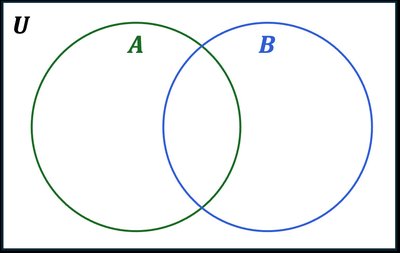
A subset is a set whose elements are all contained within another set. Venn diagrams are used to visually represent sets and their relationships.
Subset (⊆): B ⊆ A means every element of B is also in A.
Proper Subset (⊂): B ⊂ A means B is a subset of A, but B ≠ A.
The empty set is a subset of every set.
Examples and Practice
List all subsets and proper subsets for a given set.
Use Venn diagrams to visualize subset relationships.

Complement of a Set
Definition and Visualization
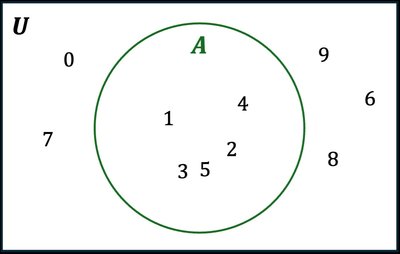
The complement of a set A, denoted A', is the set of all elements in the universal set U that are not in A.
Notation: A' = U − A
Example: If U = {11, 12, 13, 14, 15, 16} and A = {12, 15, 16}, then A' = {11, 13, 14}.
Intersections & Unions
Intersection
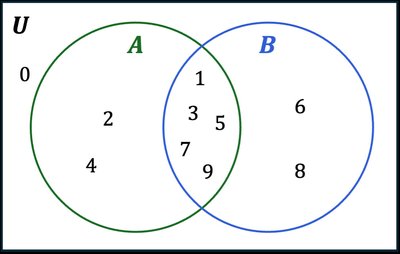
The intersection of two sets A and B, denoted A ∩ B, is the set of elements common to both sets.
Notation: A ∩ B = {x | x ∈ A and x ∈ B}
Example: If A = {2, 4, 5}, B = {4, 5, 7, 8}, then A ∩ B = {4, 5}.
Disjoint Sets: Two sets with no common elements are called disjoint.
Union
The union of two sets A and B, denoted A ∪ B, is the set of all elements in either A or B (or both).
Notation: A ∪ B = {x | x ∈ A or x ∈ B}
Example: If A = {1, 3, 5, 7, 9}, B = {7, 9, 11, 13}, then A ∪ B = {1, 3, 5, 7, 9, 11, 13}.
Venn Diagrams & Operations with Three Sets
Three-Set Operations
Set operations can be extended to three or more sets. Venn diagrams help visualize these relationships.
Intersection: A ∩ B ∩ C is the set of elements common to all three sets.
Union: A ∪ B ∪ C is the set of elements in at least one of the sets.
Complex Operations: Operations such as (B ∪ C) ∩ A' and (B ∩ A') ∪ (C ∩ A') can be visualized and compared using Venn diagrams.
Set Applications: Survey Problems
Survey Problems and Venn Diagrams
Survey results can be analyzed using sets and Venn diagrams. Each region in a Venn diagram represents a group of participants with specific characteristics.
Counting Participants: To find the number of participants in a group, sum the responses in each relevant region.
Example: If 95 students read fiction, 70 read non-fiction, and 32 read both, a Venn diagram can be used to determine how many read only fiction, only non-fiction, or both.
Step-by-Step: Define sets, draw the Venn diagram, label regions, and answer questions based on the diagram.
Practice and Examples
Use Venn diagrams to solve survey problems involving two or three sets.
Apply set operations to determine the number of participants in overlapping groups.
Key Formulas
Intersection:
Union:
Complement:
Subset:
