 Back
Venn Diagrams & Operations with Three Sets – Study Guidance
Study Guide - Smart Notes
 Tailored notes based on your materials, expanded with key definitions, examples, and context.
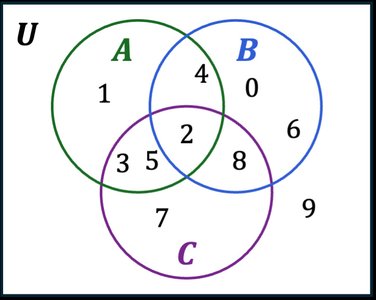
Q1. Find the intersection of sets A, B, and C:
Background
Topic: Set Theory & Venn Diagrams
This question tests your understanding of how to find the intersection of three sets using a Venn diagram. The intersection refers to the elements that are present in all three sets simultaneously.
Key Terms and Formulas:
Intersection (): The set of elements common to all sets involved.
Venn Diagram: A visual tool to represent sets and their relationships.
Step-by-Step Guidance
Examine the Venn diagram and identify the region where all three circles (A, B, and C) overlap.
List the element(s) that appear in this overlapping region. These are the elements that belong to A, B, and C simultaneously.
Write the intersection set using roster notation:
Double-check that the element(s) you listed are indeed present in all three sets by referencing the original sets.
Try solving on your own before revealing the answer!
Final Answer:
The only element that appears in all three sets (A, B, and C) is 2, as shown in the central overlap of the Venn diagram.
Q2. Find
Background
Topic: Set Operations (Union and Intersection)
This question tests your ability to combine set operations: first finding the intersection of B and C, then taking the union with A. The union includes all elements in A or in the intersection of B and C.
Key Terms and Formulas:
Union (): The set of all elements in either set.
Intersection (): The set of elements common to both sets.
Step-by-Step Guidance
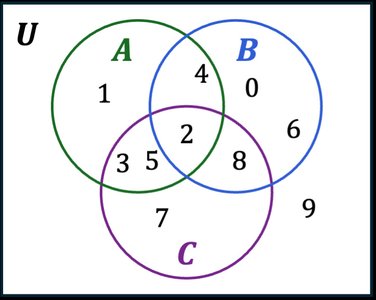
First, identify the elements in by finding the overlap between sets B and C in the Venn diagram.
Next, list all elements in set A.
Combine the elements from A and to form the union .
Write the resulting set in roster notation, making sure not to repeat any elements.
Try solving on your own before revealing the answer!
Final Answer:
Elements in A are {1, 2, 3, 4, 5}. The intersection is {2, 8}. The union is {1, 2, 3, 4, 5, 8}.
Q3. Shade on the Venn diagram
Background
Topic: Set Complements and Venn Diagram Shading
This question asks you to visualize and shade the region corresponding to on a Venn diagram. is the complement of A, meaning all elements not in A.
Key Terms and Formulas:
Complement (): All elements in the universal set U that are not in A.
Union (): All elements in B or C.
Intersection (): Elements common to both sets.
Step-by-Step Guidance
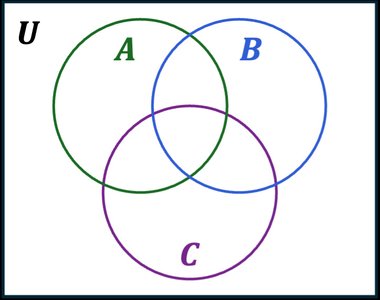
Identify the region representing (all elements in B or C).
Determine the region representing (all elements outside A).
Find the overlap between and —this is the region to shade.
Carefully shade only the parts of B and C that do not overlap with A.
Try solving on your own before revealing the answer!
Final Answer: The shaded region is the part of B and C that does not overlap with A.
On the Venn diagram, shade the regions of B and C that are outside A. This includes elements in B and C but not in A.
Q4. Shade on the Venn diagram
Background
Topic: Set Operations and Venn Diagram Visualization
This question asks you to shade the regions corresponding to on a Venn diagram. This involves finding elements in B and C that are not in A, then combining those regions.
Key Terms and Formulas:
Intersection (): Elements common to both sets.
Union (): All elements in either set.
Complement (): All elements not in A.
Step-by-Step Guidance
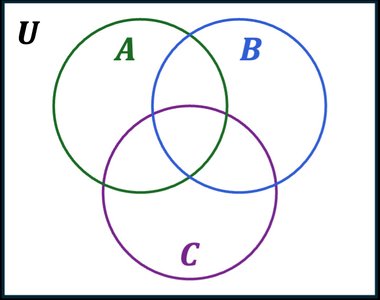
Identify the region representing (elements in B but not in A).
Identify the region representing (elements in C but not in A).
Combine these two regions by shading both on the Venn diagram.
Make sure not to shade any region that overlaps with A.
Try solving on your own before revealing the answer!
Final Answer: The shaded region is the union of B and C outside A.
Shade the regions in B and C that do not overlap with A. This includes all elements in B and C except those also in A.
Q5. What can you conclude about the relationship between and ?
Background
Topic: Set Theory – Distributive Laws
This question tests your understanding of how set operations relate to each other, specifically whether the two expressions are equivalent.
Key Terms and Formulas:
Distributive Law:
Set Equivalence: Two sets are equivalent if they contain exactly the same elements.
Step-by-Step Guidance
Compare the regions shaded in the previous two questions.
Analyze whether the two expressions produce the same set of elements.
Use the distributive law to rewrite one expression and see if it matches the other.
Check for any differences or similarities in the elements included in each set.
Try solving on your own before revealing the answer!
Final Answer: The two expressions are equivalent.
By the distributive law, . Both expressions describe the same set.
