 Back
Venn Diagrams and Set Theory in Liberal Arts Math
Study Guide - Smart Notes
 Tailored notes based on your materials, expanded with key definitions, examples, and context.
Q1. Fitness Classes Venn Diagram Interpretation
Background
Topic: Venn Diagrams & Set Theory
This question is testing your ability to interpret and analyze Venn diagrams, which are used to visually represent sets and their relationships, such as intersections and unions. This is a common topic in Liberal Arts Math, especially in sections about logic, sets, and probability.
Key Terms and Formulas:
Set: A collection of distinct objects.
Intersection: The set of elements common to both sets (represented by the overlap).
Union: The set of elements in either or both sets.
Complement: The set of elements not in a given set.
Formula for union of two sets:
Step-by-Step Guidance
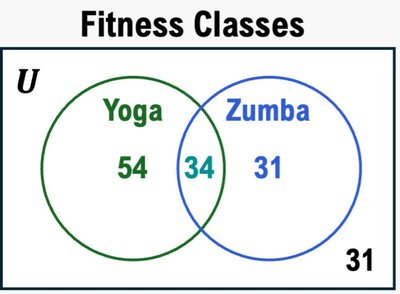
Identify the numbers in each region of the Venn diagram: 54 (Yoga only), 31 (Zumba only), 34 (both Yoga and Zumba), and 31 (neither).
Recall that the intersection (overlap) represents people who attend both Yoga and Zumba classes.
To find the total number of people in the universal set , add all the numbers in the diagram.
To find the number of people who attend at least one class, add the numbers in the Yoga only, Zumba only, and both regions.
Set up the formula for the union of the two sets using the numbers provided.
Try solving on your own before revealing the answer!
Final Answer:
Total number of people in is .
Number of people who attend at least one class is .
The union formula confirms this: .
These calculations show how to use Venn diagrams to analyze sets and their relationships.
Q2. Study Methods Venn Diagram Interpretation
Background
Topic: Venn Diagrams & Set Theory (Three Sets)
This question is testing your ability to interpret a Venn diagram with three sets, which is a more advanced application of set theory. You will analyze intersections, unions, and complements among three groups.
Key Terms and Formulas:
Intersection of three sets: The region where all three sets overlap.
Union of three sets: The set of elements in at least one of the sets.
Formula for union of three sets:
Step-by-Step Guidance
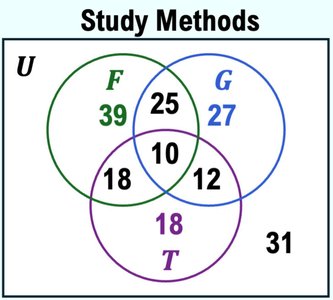
Identify the numbers in each region of the Venn diagram: 39 (F only), 27 (G only), 18 (T only), 25 (F and G), 18 (F and T), 12 (G and T), 10 (all three), and 31 (neither).
Recall that the intersection of all three sets (10) represents people who use all three study methods.
To find the total number of people in , add all the numbers in the diagram.
To find the number of people who use at least one study method, add all regions except the 'neither' region.
Set up the formula for the union of three sets using the numbers provided.
Try solving on your own before revealing the answer!
Final Answer:
Total number of people in is .
Number of people who use at least one study method is .
The union formula confirms this: .
This demonstrates how to analyze three-set Venn diagrams in set theory.
Q3. Blank Three-Set Venn Diagram
Background
Topic: Venn Diagrams & Set Theory (Three Sets)
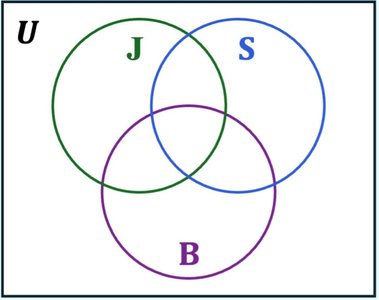
This diagram is used to practice labeling and organizing sets and their intersections. It is a foundational tool for visualizing relationships among three sets, which is important in set theory and probability.
Key Terms and Formulas:
Set labels: J, S, B represent three different sets.
Intersection: The overlapping regions represent elements common to two or three sets.
Union: The total area covered by all three circles.
Step-by-Step Guidance
Identify the three sets represented by the circles: J, S, and B.
Recall that the overlapping regions represent intersections between sets.
Practice labeling each region with hypothetical numbers or elements to represent different intersections and unions.
Set up the formula for the union of three sets, as shown above.
Try solving on your own before revealing the answer!
Final Answer:
This blank Venn diagram is a template for organizing and visualizing relationships among three sets. You can use it to practice labeling intersections, unions, and complements, which is essential for understanding set theory.
Once you assign values or elements to each region, you can apply the union and intersection formulas to analyze the sets.
