Skip to main content
Macroeconomics
My Course
Learn
Exam Prep
AI Tutor
Study Guides
Flashcards
Explore
Try the app
My Course
Learn
Exam Prep
AI Tutor
Study Guides
Flashcards
Explore
Try the app
Back
AE Model: Private Open Economy definitions
You can tap to flip the card.
Aggregate Expenditures
You can tap to flip the card.
👆
Aggregate Expenditures
Total spending in an economy, including consumption, investment, and net exports, used to determine equilibrium GDP.
Track progress
Control buttons has been changed to "navigation" mode.
1/14
Related flashcards
Related practice
Recommended videos
AE Model: Private Open Economy quiz
AE Model: Private Open Economy
15 Terms
AE Model: Private Open Economy
15. Deriving the Aggregate Expenditures Model
10 problems
Topic
AE Model and the Multiplier
15. Deriving the Aggregate Expenditures Model
10 problems
Topic
16. Deriving the Aggregate Expenditures Model
7 topics
13 problems
Chapter
Guided course
05:37
Private Open Economy
1499
views
18
rank
Terms in this set (14)
Hide definitions
Aggregate Expenditures
Total spending in an economy, including consumption, investment, and net exports, used to determine equilibrium GDP.
Private Open Economy
Economic system with households and firms, no government, and international trade present.
Consumption Function
Mathematical relationship showing how spending by households changes with income, often with a fixed intercept and a marginal propensity.
Investment
Spending by firms on capital goods, added to consumption to calculate total expenditures in the model.
Net Exports
Difference between a country's exports and imports, included in total spending for open economies.
Macroeconomic Equilibrium
Point where total spending equals total production, typically found where two lines intersect on a graph.
45-Degree Line
Graphical tool representing all points where spending equals output, used to find equilibrium.
Multiplier Effect
Process where a change in spending leads to a larger change in GDP due to repeated rounds of income and spending.
GDP
Total value of all goods and services produced within a country, used as a measure of output.
Marginal Propensity to Consume
Fraction of additional income that households spend on consumption, determining the slope of the consumption function.
Intercept
Constant term in a linear function, representing spending when income is zero.
Slope
Rate at which spending increases as income rises, often determined by the marginal propensity to consume.
Trade
Exchange of goods and services with other countries, distinguishing open from closed economies.
Government Purchases
Spending by the public sector, excluded from the private open economy model.
 BackBack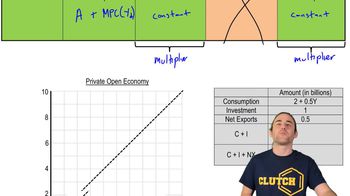
 05:37
05:37