Back

Aggregate Expenditures Model and Macroeconomic Equilibrium definitions

Control buttons has been changed to "navigation" mode.
1/13
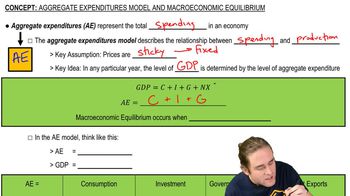
  • Aggregate Expenditures

    Total spending in an economy, including consumption, investment, government purchases, and net exports.
  • AE Model

    A framework analyzing the relationship between total spending and production, assuming fixed prices.
  • Sticky Prices

    A situation where prices remain constant, not adjusting in response to changes in supply or demand.
  • Equilibrium

    A state where total spending matches total production, resulting in no unplanned changes in inventories.
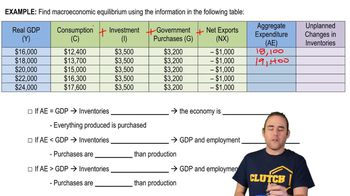
  • Real GDP

    A measure of production that removes the effects of price changes, reflecting actual output.
  • Consumption Function

    A relationship showing how spending by households depends on disposable income and a base level of spending.
  • Marginal Propensity to Consume

    The fraction of each additional dollar of income that is spent rather than saved.
  • Disposable Income

    Income available to households after taxes, used for spending or saving.
  • Investment

    Spending by businesses on capital goods, treated as a constant in this model.
  • Government Purchases

    Expenditures by the public sector on goods and services, considered fixed in the model.
  • Net Exports

    The value of exports minus imports, representing foreign sector spending, held constant in this context.
  • Multiplier Effect

    The process by which an initial change in spending leads to a larger change in overall output.
  • Production

    The total output of goods and services generated within an economy during a period.