Skip to main content
Macroeconomics
My Course
Learn
Exam Prep
AI Tutor
Study Guides
Flashcards
Explore
Try the app
My Course
Learn
Exam Prep
AI Tutor
Study Guides
Flashcards
Explore
Try the app
Back
Monetary vs Fiscal Policy definitions
You can tap to flip the card.
Monetary Policy
You can tap to flip the card.
👆
Monetary Policy
A central bank's toolset for adjusting interest rates and money supply to influence spending and economic activity.
Track progress
Control buttons has been changed to "navigation" mode.
1/15
Related flashcards
Related practice
Recommended videos
Monetary vs Fiscal Policy quiz #1
Monetary vs Fiscal Policy
10 Terms
Goals of Monetary Policy
18. Monetary Policy
9 problems
Topic
19. Monetary Policy
8 topics
14 problems
Chapter
Guided course
03:13
Monetary vs Fiscal Policy
614
views
36
rank
Terms in this set (15)
Hide definitions
Monetary Policy
A central bank's toolset for adjusting interest rates and money supply to influence spending and economic activity.
Fiscal Policy
Government actions involving changes in taxes and spending to impact disposable income, consumption, and employment.
Central Bank
An institution responsible for managing a nation's money supply and interest rates to stabilize the economy.
Interest Rate
The cost of borrowing money, which can be adjusted to encourage or discourage consumer and business spending.
Money Supply
The total amount of currency and liquid assets available in an economy, influencing overall demand and prices.
Government Spending
Expenditures by public authorities on goods, services, and infrastructure to stimulate economic activity.
Taxation
Compulsory charges imposed by the government, affecting disposable income and consumer purchasing power.
Disposable Income
The amount of money households have available for spending after taxes are deducted.
Aggregate Demand
The total demand for goods and services within an economy at a given overall price level and time.
GDP
A measure of the total value of all goods and services produced within a country, reflecting economic health.
Unemployment
The condition where individuals willing and able to work cannot find jobs, often influenced by economic policies.
Inflation
A general increase in prices across the economy, reducing purchasing power and often targeted by stabilization policies.
Economic Decline
A period marked by reduced economic activity, lower spending, and rising joblessness, prompting policy intervention.
Business Cycle
The recurring pattern of economic expansion and contraction, influenced by stabilization efforts.
Policymaker
An elected official or authority responsible for designing and implementing government economic strategies.
 BackBack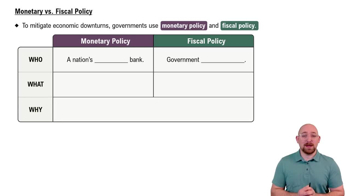
 03:13
03:13