Skip to main content
Macroeconomics
My Course
Learn
Exam Prep
AI Tutor
Study Guides
Flashcards
Explore
Try the app
My Course
Learn
Exam Prep
AI Tutor
Study Guides
Flashcards
Explore
Try the app
Back
Short Run Aggregate Supply definitions
You can tap to flip the card.
Short Run Aggregate Supply
You can tap to flip the card.
👆
Short Run Aggregate Supply
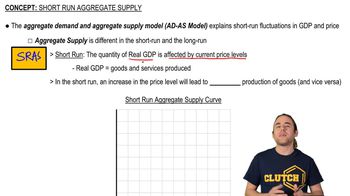
An upward sloping curve showing the positive relationship between overall price levels and real GDP in the short term.
Track progress
Control buttons has been changed to "navigation" mode.
1/14
Related flashcards
Related practice
Recommended videos
Short Run Aggregate Supply quiz #1
Short Run Aggregate Supply
10 Terms
Short Run Aggregate Supply
16. Aggregate Demand and Aggregate Supply Analysis
10 problems
Topic
Shifting Short Run Aggregate Supply
16. Aggregate Demand and Aggregate Supply Analysis
10 problems
Topic
17. Aggregate Demand and Aggregate Supply Analysis
8 topics
15 problems
Chapter
Guided course
04:16
Short Run Aggregate Supply Slopes Upwards
2198
views
47
rank
Guided course
02:52
Short Run Aggregate Supply
2490
views
41
rank
Terms in this set (14)
Hide definitions
Short Run Aggregate Supply
An upward sloping curve showing the positive relationship between overall price levels and real GDP in the short term.
Aggregate Demand
Total spending on goods and services in an economy at different price levels, interacting with aggregate supply.
Real GDP
The total value of goods and services produced, adjusted for inflation, reflecting actual output.
Price Level
A measure representing the average prices of goods and services in an economy at a given time.
Sticky Wage Theory
A concept where wage rates are slow to adjust, causing profits to rise when prices increase faster than wages.
Sticky Price Theory
A concept where some prices are slow to change due to costs like menu costs, affecting output when general prices rise.
Misperceptions Theory
A concept where firms increase production when they mistakenly interpret rising prices as higher demand for their products.
Menu Costs
Expenses businesses face when changing prices, such as reprinting menus, leading to reluctance in frequent price adjustments.
Factors of Production
Inputs like labor and capital that determine the maximum possible output in the long run.
Union Wages
Wage rates set by collective agreements, often fixed for several years, contributing to wage stickiness.
Profit
The difference between revenue from sales and the costs of production, which can rise if prices increase faster than costs.
Output
The quantity of goods and services produced in an economy, often measured by real GDP.
Economic Boom
A period of rising economic activity, often associated with increasing prices and output.
Market Supply
The total quantity of a good or service that producers are willing to sell at various prices in a market.
 BackBack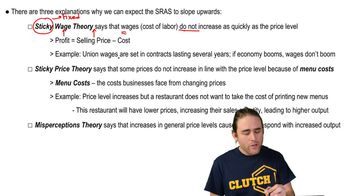
 04:16
04:16