Skip to main content
Macroeconomics
My Course
Learn
Exam Prep
AI Tutor
Study Guides
Flashcards
Explore
Try the app
My Course
Learn
Exam Prep
AI Tutor
Study Guides
Flashcards
Explore
Try the app
Back
The Laffer Curve quiz
You can tap to flip the card.
What does the Laffer Curve illustrate about the relationship between tax rates and tax revenue?
You can tap to flip the card.
👆
What does the Laffer Curve illustrate about the relationship between tax rates and tax revenue?
The Laffer Curve shows that increasing tax rates does not always lead to higher tax revenue because higher taxes can reduce the quantity exchanged.
Track progress
Control buttons has been changed to "navigation" mode.
1/15
Related flashcards
Related practice
Recommended videos
The Laffer Curve definitions
The Laffer Curve
15 Terms
The Laffer Curve
6. Introduction to Taxes
10 problems
Topic
Quantitative Analysis of Taxes
6. Introduction to Taxes
3 problems
Topic
6. Introduction to Taxes
6 topics
14 problems
Chapter
Guided course
09:01
The Laffer Curve
1953
views
9
rank
Terms in this set (15)
Hide definitions
What does the Laffer Curve illustrate about the relationship between tax rates and tax revenue?
The Laffer Curve shows that increasing tax rates does not always lead to higher tax revenue because higher taxes can reduce the quantity exchanged.
How does a small tax affect tax revenue and quantity exchanged?
A small tax results in a small tax revenue because, although the quantity exchanged is high, the tax per unit is low.
What happens to tax revenue when a very large tax is imposed?
A very large tax significantly reduces the quantity exchanged, so tax revenue decreases despite the higher tax per unit.
Why does the quantity exchanged decrease as the size of the tax increases?
As taxes increase, the cost to buyers rises and the price received by sellers falls, discouraging both from participating in the market.
How is tax revenue calculated in the context of the Laffer Curve?
Tax revenue is calculated as the amount of tax per unit multiplied by the quantity exchanged.
What does the area of the 'tax revenue box' represent on a supply and demand graph?
The area of the box represents the total tax revenue collected by the government.
Why might a medium-sized tax maximize tax revenue?
A medium-sized tax balances a reasonable tax per unit with a still substantial quantity exchanged, maximizing the area of the tax revenue box.
What shape does the Laffer Curve typically have when graphed?
The Laffer Curve is parabolic, rising to a maximum point and then falling as tax rates continue to increase.
Who created the concept of the Laffer Curve?
Arthur Laffer created the concept of the Laffer Curve.
According to Arthur Laffer, where was the USA positioned on the Laffer Curve when he introduced his idea?
Laffer suggested the USA was on the downward slope of the curve, meaning further tax increases would reduce tax revenue.
What is the key takeaway for optimal tax policy from the Laffer Curve?
Optimal tax policy should find a balance that maximizes tax revenue without overly discouraging economic activity.
What happens to tax revenue if taxes are increased when already on the downward slope of the Laffer Curve?
Increasing taxes further will decrease tax revenue because the reduction in quantity exchanged outweighs the higher tax per unit.
How does the Laffer Curve explain the effect of taxes on economic activity?
It shows that excessively high taxes discourage economic activity, reducing the quantity exchanged and thus tax revenue.
What does the x-axis and y-axis represent on a Laffer Curve graph?
The x-axis represents the size of the tax, and the y-axis represents the amount of tax revenue.
Why can't we specify the exact tax rate that maximizes revenue for every market?
Because the optimal tax rate depends on the specific characteristics of each market, such as demand and supply elasticity.
 BackBack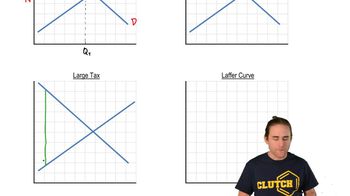
 09:01
09:01