Skip to main content
Microbiology
My Course
Learn
Exam Prep
AI Tutor
Study Guides
Textbook Solutions
Flashcards
Explore
Try the app
My Course
Learn
Exam Prep
AI Tutor
Study Guides
Textbook Solutions
Flashcards
Explore
Try the app
Back
ABC Transporters definitions
You can tap to flip the card.
ABC Transporters
You can tap to flip the card.
👆
ABC Transporters
Integral membrane proteins using ATP hydrolysis to move substances against their concentration gradient, crucial in drug resistance.
Track progress
Control buttons has been changed to "navigation" mode.
1/14
Related flashcards
Related practice
Recommended videos
ABC Transporters quiz #1
ABC Transporters
10 Terms
ABC Transporters
6. Cell Membrane & Transport
3 problems
Topic
Monica
Group Translocation
6. Cell Membrane & Transport
3 problems
Topic
Brendan
6. Cell Membrane & Transport - Part 1 of 2
7 topics
12 problems
Chapter
Monica
6. Cell Membrane & Transport - Part 2 of 2
8 topics
13 problems
Chapter
Brendan
06:20
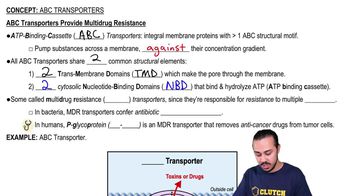
ABC Transporters Provide Multidrug Resistance
2449
views
12
rank
1
comments
Terms in this set (14)
Hide definitions
ABC Transporters
Integral membrane proteins using ATP hydrolysis to move substances against their concentration gradient, crucial in drug resistance.
ATP-Binding Cassette
A structural motif within certain proteins that binds ATP, enabling energy-dependent transport across membranes.
Primary Active Transport
A process where substances are moved across membranes against gradients using direct energy from ATP hydrolysis.
Transmembrane Domains
Protein regions spanning the membrane, forming a pore for molecule passage in transport proteins.
Nucleotide-Binding Domains
Cytosolic protein regions that bind and hydrolyze ATP, powering substrate movement in transporters.
ATPase
An enzyme class that catalyzes ATP hydrolysis, providing energy for active transport processes.
Concentration Gradient
A difference in substance concentration across a membrane, often dictating the direction of molecular movement.
Multidrug Resistance
A phenomenon where cells expel various drugs, reducing treatment effectiveness, often due to specific transporters.
MDR Transporters
Proteins capable of exporting multiple drugs or toxins from cells, contributing to resistance in microbes and tumors.
Antibiotic Resistance
A condition where bacteria survive antibiotic exposure, frequently due to efflux by specialized transport proteins.
P-Glycoprotein
A human transporter protein that removes anticancer drugs from tumor cells, impacting chemotherapy outcomes.
Plasma Membrane
A cell boundary composed of a lipid bilayer, hosting various transport proteins for substance movement.
Hydrolysis
A chemical reaction involving water to break bonds, such as splitting ATP to release energy for transport.
Toxins
Harmful substances that can be expelled from cells by specialized transporters to protect cellular function.
 BackBack
 06:20
06:20