Skip to main content
Microbiology
My Course
Learn
Exam Prep
AI Tutor
Study Guides
Textbook Solutions
Flashcards
Explore
Try the app
My Course
Learn
Exam Prep
AI Tutor
Study Guides
Textbook Solutions
Flashcards
Explore
Try the app
Back
Active Transport definitions
You can tap to flip the card.
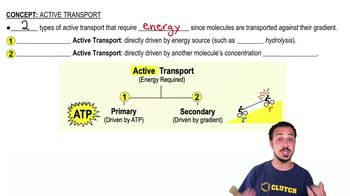
Active Transport
You can tap to flip the card.
👆
Active Transport
Cellular process requiring energy to move molecules from low to high concentration, essential for maintaining gradients.
Track progress
Control buttons has been changed to "navigation" mode.
1/15
Related flashcards
Related practice
Recommended videos
Active Transport quiz
Active Transport
15 Terms
Active Transport
6. Cell Membrane & Transport
4 problems
Topic
Monica
ABC Transporters
6. Cell Membrane & Transport
3 problems
Topic
Monica
6. Cell Membrane & Transport - Part 1 of 2
7 topics
12 problems
Chapter
Monica
6. Cell Membrane & Transport - Part 2 of 2
8 topics
13 problems
Chapter
Brendan
06:57
Secondary Active Transport
17188
views
195
rank
02:37
Active Transport
20873
views
303
rank
02:53
Primary Active Transport
18869
views
257
rank
Terms in this set (15)
Hide definitions
Active Transport
Cellular process requiring energy to move molecules from low to high concentration, essential for maintaining gradients.
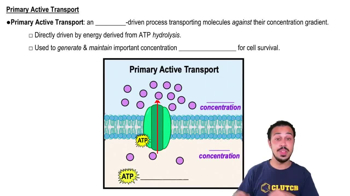
Primary Active Transport
Mechanism using ATP hydrolysis directly to move substances against their concentration gradients via membrane proteins.
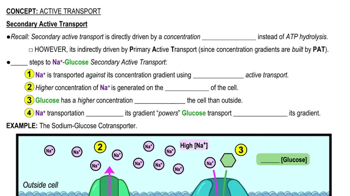
Secondary Active Transport
Transport system powered by the gradient of another molecule, not directly by ATP, but dependent on primary active transport.
ATP Hydrolysis
Chemical reaction releasing energy from ATP, directly fueling primary active transport processes in cells.
Concentration Gradient
Difference in molecule concentration across a membrane, driving movement in both passive and active transport.
Membrane Protein
Integral component of the cell membrane facilitating the movement of molecules during active transport.
Sodium-Potassium Pump
Antiporter exporting three sodium ions and importing two potassium ions, crucial for cellular ion balance.
Antiporter
Transport protein moving two different ions or molecules in opposite directions across a membrane.
Sodium-Glucose Transporter
Secondary active transport protein using sodium gradient to import glucose against its concentration gradient.
Ion Gradient
Unequal distribution of ions across a membrane, vital for processes like nerve signaling and nutrient uptake.
Plasma Membrane
Selective barrier surrounding cells, hosting proteins responsible for active transport mechanisms.
Sodium Ion
Positively charged particle exported by the sodium-potassium pump, establishing gradients for cellular activities.
Potassium Ion
Positively charged particle imported by the sodium-potassium pump, maintaining internal cellular environment.
Glucose
Simple sugar transported into cells via secondary active transport, essential for cellular energy.
Energy Requirement
Necessity for input, often from ATP, to move molecules against their natural flow in active transport.
 BackBack
 06:57
06:57