Back

Animal Viruses: 4. Assembly Inside Host Cell quiz

Control buttons has been changed to "navigation" mode.
1/15
  • What is the fourth step of animal virus infection?

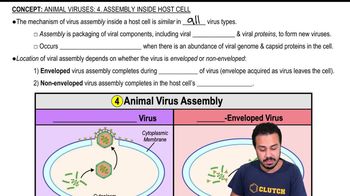
    The fourth step is the assembly of the virus inside the host cell, where viral components are packaged together to form new viruses.
  • What components are packaged during viral assembly?

    The viral genome and viral proteins are packaged together during viral assembly.
  • When does viral assembly occur inside the host cell?

    Viral assembly occurs spontaneously when there is an abundance of viral genome and capsid proteins in the cell.
  • What determines the location of viral assembly in the host cell?

    The location depends on whether the virus is enveloped or non-enveloped.
  • Where does the nucleocapsid assembly of enveloped viruses occur?

    The nucleocapsid assembly of enveloped viruses occurs in the cytoplasm.
  • When is the assembly of enveloped viruses completed?

    The assembly is completed during the release of the virus, when it acquires its outer lipid envelope.
  • How do enveloped viruses acquire their outer lipid envelope?

    They acquire the envelope from the host cell's cytoplasmic membrane as the virus is being released.
  • Where is the assembly of non-enveloped viruses completed?

    The assembly of non-enveloped viruses is completed entirely within the cytoplasm before the virus is released.
  • Do non-enveloped viruses acquire a lipid envelope during release?

    No, non-enveloped viruses do not acquire a lipid envelope; their assembly is finished before release.
  • What is the main difference in assembly between enveloped and non-enveloped viruses?

    Enveloped viruses complete assembly during release by acquiring an envelope, while non-enveloped viruses complete assembly in the cytoplasm before release.
  • Why is understanding virus assembly important?

    Understanding virus assembly is crucial for learning about the next step, which is the release of the virus.
  • What triggers the spontaneous assembly of viruses inside the host cell?

    An abundance of viral genome and capsid proteins triggers spontaneous assembly.
  • What is the nucleocapsid composed of?

    The nucleocapsid is composed of the viral nucleic acid and the protein shell.
  • What happens after the assembly step in animal virus infection?

    After assembly, the next step is the release of the animal virus from the host cell.
  • Do all viruses assemble in the same way inside the host cell?

    The basic mechanism is similar, but the location and completion of assembly differ between enveloped and non-enveloped viruses.