Back

Animal Viruses: 5. Release from Host Cell definitions

Control buttons has been changed to "navigation" mode.
1/15
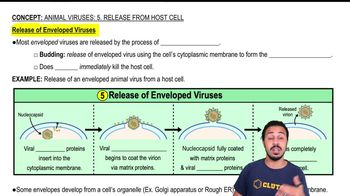
  • Budding

    A process where viral particles exit a host cell by wrapping themselves in a portion of the cell's membrane, forming a lipid envelope.
  • Cytoplasmic Membrane

    A cellular boundary used by enveloped viruses to acquire their outer lipid layer during release.
  • Lipid Envelope

    A membrane-derived layer surrounding some viruses, obtained from host cell membranes during exit.
  • Nucleocapsid

    A viral structure composed of genetic material encased in a protein shell, often coated by matrix proteins during assembly.
  • Spike Proteins

    Viral surface molecules that embed into host membranes, facilitating envelope formation and later host cell recognition.
  • Matrix Proteins

    Proteins that connect the nucleocapsid to the forming viral envelope, ensuring structural integrity during budding.
  • Virion

    A fully assembled, infectious viral particle released from the host cell, capable of initiating new infections.
  • Golgi Apparatus

    A cellular organelle that can provide membrane material for viral envelopes in some enveloped viruses.
  • Rough Endoplasmic Reticulum

    A membrane-bound organelle that may contribute its membrane to the viral envelope during virus release.
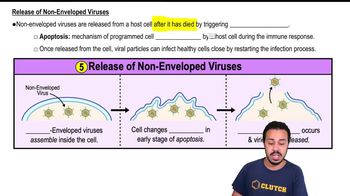
  • Apoptosis

    A programmed cell death mechanism, often triggered by immune responses, enabling non-enveloped virus release.
  • Non-enveloped Virus

    A type of virus lacking a lipid envelope, released after host cell death, often via apoptosis.
  • Enveloped Virus

    A virus surrounded by a lipid membrane derived from host cell structures during the release process.
  • Vesicles

    Small membrane-bound sacs that transport viral particles from organelles to the cell exterior during release.
  • Programmed Cell Death

    A regulated cellular process leading to self-destruction, facilitating the escape of non-enveloped viruses.
  • Immune Response

    A host defense mechanism that can trigger apoptosis, indirectly aiding the release of non-enveloped viruses.