How many chemically distinct classes of human immunoglobulins (antibodies) are there?
There are five chemically distinct classes of human immunoglobulins (antibodies).
Antibodies ______.
Antibodies are Y-shaped proteins produced by plasma cells that specifically bind to antigens to generate an immune response.
What are the two types of polypeptide chains found in an antibody?
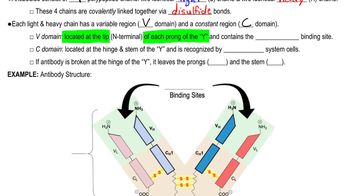
Antibodies have two identical light chains and two identical heavy chains, which are covalently linked by disulfide bonds.
Where is the variable (V) domain located on an antibody, and what is its function?
The variable (V) domain is located at the tips of the 'Y' prongs and contains the antigen-binding site, allowing for specificity in binding different antigens.
What is the role of the constant (C) domain in antibodies?
The constant (C) domain forms the rest of the antibody structure and is recognized by immune system cells, facilitating immune responses.
How are the four polypeptide chains in an antibody held together?
The chains are covalently linked together via disulfide bonds between cysteine residues.
What are the FAB and FC regions of an antibody, and how are they formed?
The FAB region contains the antigen-binding sites and is formed by breaking the antibody at the hinge, while the FC region contains the constant region and forms the stem of the 'Y'.
Why can the human immune system produce more antibodies than the number of genes in the genome?
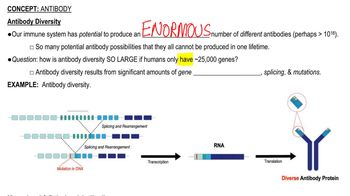
Antibody diversity is achieved through gene rearrangements, splicing, and mutations, allowing for a vast array of specificities beyond the number of genes.
What process allows for the creation of different antibody specificities during antibody production?
Gene rearrangement, splicing, and mutations during transcription and translation create different antibody specificities.
What is the estimated potential number of different antibodies the human immune system can produce?
The human immune system can potentially produce over 1 quintillion (10^18) different antibodies.