Back

ATP definitions

Control buttons has been changed to "navigation" mode.
1/15
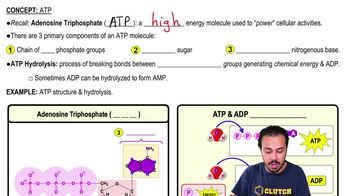
  • Adenosine Triphosphate

    A high-energy molecule with adenosine and three phosphate groups, serving as the main energy currency for cellular activities.
  • Adenosine

    A molecule formed by a pentose sugar and an adenine nitrogenous base, making up part of ATP's structure.
  • Phosphate Group

    A chemical group consisting of phosphorus and oxygen atoms, crucial for ATP's energy storage and transfer.
  • Pentose Sugar

    A five-carbon sugar component of adenosine, providing structural support in ATP.
  • Adenine

    A nitrogenous base that, together with a pentose sugar, forms adenosine in ATP.
  • ATP Hydrolysis

    A process where water breaks bonds between phosphate groups in ATP, releasing energy and forming ADP.
  • Adenosine Diphosphate

    A molecule with adenosine and two phosphate groups, produced after ATP loses one phosphate during hydrolysis.
  • Adenosine Monophosphate

    A molecule with adenosine and a single phosphate group, formed after further hydrolysis of ADP.
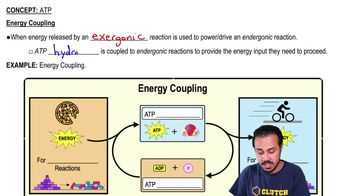
  • Energy Coupling

    A mechanism where energy from exergonic reactions, like ATP hydrolysis, powers endergonic cellular processes.
  • Exergonic Reaction

    A chemical process that releases energy, often used to drive ATP synthesis or power cellular work.
  • Endergonic Reaction

    A chemical process requiring energy input, often fueled by energy released from ATP hydrolysis.
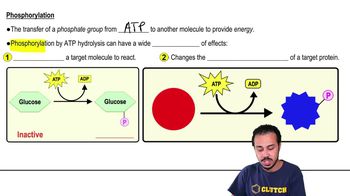
  • Phosphorylation

    A process where a phosphate group is transferred from ATP to another molecule, altering its activity or structure.
  • Protein Conformation

    The three-dimensional shape of a protein, which can be changed by phosphorylation, affecting its function.
  • Chemical Energy

    A form of stored energy within molecular bonds, especially in ATP, used to power cellular functions.
  • Kinetic Energy

    The energy of motion in cells, such as muscle contraction, ultimately derived from ATP hydrolysis.