Skip to main content
Microbiology
My Course
Learn
Exam Prep
AI Tutor
Study Guides
Textbook Solutions
Flashcards
Explore
Try the app
My Course
Learn
Exam Prep
AI Tutor
Study Guides
Textbook Solutions
Flashcards
Explore
Try the app
Back
Bacterial Transformation definitions
You can tap to flip the card.
Bacterial Transformation
You can tap to flip the card.
👆
Bacterial Transformation
A process where cells acquire external genetic material from their surroundings, leading to new traits.
Track progress
Control buttons has been changed to "navigation" mode.
1/14
Related flashcards
Related practice
Recommended videos
Bacterial Transformation quiz #1
Bacterial Transformation
10 Terms
Bacterial Transformation
16. Microbial Genetics
5 problems
Topic
Nicole
Transduction
16. Microbial Genetics
4 problems
Topic
Brendan
16. Microbial Genetics - Part 1 of 2
9 topics
14 problems
Chapter
Monica
16. Microbial Genetics - Part 2 of 2
8 topics
13 problems
Chapter
Nicole
03:06
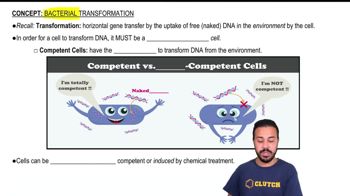
Bacterial Transformation
2110
views
12
rank
03:49
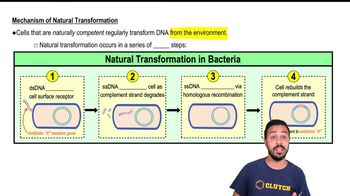
Mechanism of Natural Transformation
1814
views
18
rank
Terms in this set (14)
Hide definitions
Bacterial Transformation
A process where cells acquire external genetic material from their surroundings, leading to new traits.
Horizontal Gene Transfer
Movement of genetic material between organisms without reproduction, enabling rapid genetic change.
Naked DNA
Genetic material found free in the environment, not enclosed within a cell or viral particle.
Competent Cell
A cell in a specialized physiological state that allows uptake and incorporation of external DNA.
Noncompetent Cell
A cell lacking the ability to uptake external DNA due to absence of necessary physiological state.
Natural Transformation
Acquisition of environmental DNA by naturally capable cells, often from lysed neighboring cells.
Cell Surface Receptor
A molecular structure on the cell membrane that binds external DNA, initiating its uptake.
Double-Stranded DNA
A DNA molecule composed of two complementary strands, often the initial form taken up during transformation.
Single-Stranded DNA
A DNA molecule consisting of only one strand, which enters the cell during transformation.
Homologous Recombination
A genetic process where incoming DNA integrates into the host chromosome at similar sequences.
Chromosome
A circular DNA structure in bacteria containing essential genetic information.
Antibiotic Resistance Gene
A genetic sequence that provides the ability to survive exposure to specific antibiotics.
Lysis
The rupture of a cell, releasing its contents, including DNA, into the environment.
Genetic Trait
A characteristic determined by genes, which can be acquired through transformation.
 BackBack
 03:06
03:06