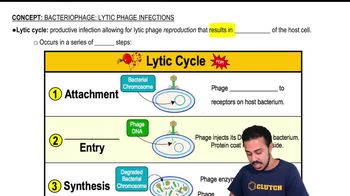
Bacteriophage: Lytic Phage Infections quiz #1 Flashcards

Bacteriophage: Lytic Phage Infections quiz #1
Control buttons has been changed to "navigation" mode.
1/10
  • Which statement best describes the lytic cycle of a viral infection in bacteriophages?
    The lytic cycle is a productive infection where a bacteriophage attaches to a host cell, injects its genome, uses the host's machinery to produce new phage components, assembles new phages, and ultimately causes the host cell to lyse, releasing newly formed bacteriophages.
  • What is the cycle that involves the rapid destruction of the host cell during bacteriophage infection?
    The lytic cycle involves the rapid destruction of the host cell, resulting in cell lysis and the release of newly produced bacteriophages.
  • During the attachment step of the lytic cycle, what does the bacteriophage interact with on the host cell?
    The bacteriophage interacts with very specific receptors on the host bacterium's cell envelope.
  • What happens to the protein coat of the bacteriophage during genome entry in the lytic cycle?
    The protein coat remains outside the host cell and is not injected; only the phage genome enters the cell.
  • How is the host bacterial chromosome affected during the synthesis step of the lytic cycle?
    Phage enzymes degrade the host DNA, chopping it into small pieces and inactivating the bacterial chromosome.
  • What is produced during the synthesis step of the lytic cycle besides phage enzymes?
    Phage proteins and phage genomes are produced during the synthesis step.
  • Where does the assembly of new bacteriophages occur during the lytic cycle?
    Assembly of new bacteriophages occurs inside the bacterial cell.
  • What is the result of the release step in the lytic cycle?
    The host cell lyses, releasing newly formed bacteriophages to infect other bacterial cells.
  • How many main steps are there in the lytic cycle of bacteriophage infection?
    There are five main steps: attachment, genome entry, synthesis, assembly, and release.
  • What allows the lytic cycle to be considered a productive infection?
    It results in the production of new phages, increasing the number of lytic bacteriophages.