Back

Biofilms definitions

Control buttons has been changed to "navigation" mode.
1/14
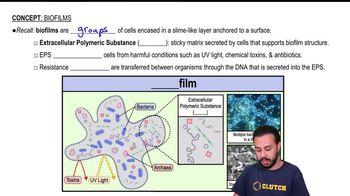
  • Biofilm

    Community of cells encased in a protective, sticky matrix anchored to a surface, enabling survival in harsh environments.
  • Extracellular Polymeric Substance

    Sticky, slime-like matrix secreted by cells, forming the structural and protective framework for communities.
  • EPS

    Abbreviation for the matrix that encases and shields cells, supporting structure and facilitating communication.
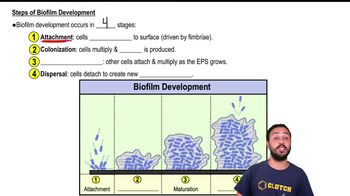
  • Attachment

    Initial stage where cells adhere to a surface, often using specialized structures, beginning community formation.
  • Colonization

    Stage where attached cells multiply and produce the protective matrix, expanding the community.
  • Maturation

    Phase where the community grows, diversifies, and incorporates additional cells, strengthening the structure.
  • Dispersal

    Final stage where cells detach from the community to establish new groups elsewhere.
  • Fimbriae

    Small bacterial structures crucial for adhering to surfaces during the initial stage of community development.
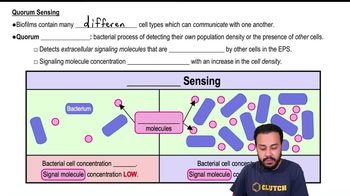
  • Quorum Sensing

    Chemical communication process allowing cells to detect population density and coordinate group behaviors.
  • Signaling Molecule

    Chemical released by cells into the matrix, enabling detection of cell density and triggering coordinated responses.
  • Cell Density

    Measurement of the number of cells within a community, influencing chemical communication and group actions.
  • Resistance Genes

    Genetic elements that can be transferred within the matrix, providing protection against harmful agents.
  • Bacteria

    Single-celled organisms commonly forming communities encased in a protective matrix on surfaces.
  • Archaea

    Microorganisms that, along with bacteria, can form structured communities within a protective matrix.