Back

Cell Envelope & Biological Membranes definitions

Control buttons has been changed to "navigation" mode.
1/13
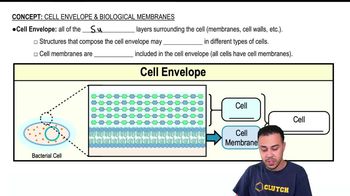
  • Cell Envelope

    All surface layers surrounding a cell, including membranes and walls, with composition varying by cell type.
  • Cell Membrane

    A universal boundary in all cells, forming part of the envelope and composed mainly of a phospholipid bilayer.
  • Cell Wall

    A structural layer outside the membrane, present in some cells, contributing to the cell envelope.
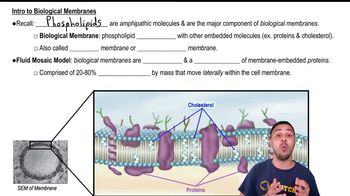
  • Phospholipid Bilayer

    A double layer of amphipathic molecules forming the main structure of biological membranes.
  • Amphipathic Molecule

    A molecule possessing both hydrophilic and hydrophobic regions, crucial for membrane structure.
  • Protein

    A major membrane component, sometimes comprising up to 80% of membrane mass, capable of lateral movement.
  • Cholesterol

    A molecule embedded in membranes, contributing to membrane structure and fluidity.
  • Fluid Mosaic Model

    A concept describing membranes as semi-fluid structures with mobile proteins and diverse components.
  • Plasma Membrane

    Another term for the cell membrane, emphasizing its role as the cell's outermost boundary.
  • Scanning Electron Micrograph

    An imaging technique used to visualize membrane surfaces at high magnification.
  • Lateral Movement

    The ability of membrane proteins and molecules to shift positions within the membrane plane.
  • Hydrophilic Group

    A region of a molecule that interacts favorably with water, present in phospholipids.
  • Hydrophobic Group

    A region of a molecule that avoids water, contributing to membrane bilayer formation.