The Glycocalyx: Capsules & Slime Layers quiz #1 Flashcards

The Glycocalyx: Capsules & Slime Layers quiz #1
Control buttons has been changed to "navigation" mode.
1/10
  • Which bacterial structure protects bacteria from being phagocytized?
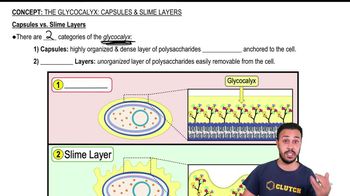
    The capsule, a highly organized and dense form of the glycocalyx, protects bacteria from being phagocytized.
  • True or false: When the bacterial glycocalyx is easily removed, it is called a capsule.
    False. When the bacterial glycocalyx is easily removed, it is called a slime layer, not a capsule.
  • What is the main chemical composition of the bacterial glycocalyx?
    The glycocalyx is primarily composed of complex polysaccharides.
  • How does the glycocalyx help bacteria survive in dry environments?
    The glycocalyx protects bacteria from dehydration by helping to retain water around the cell.
  • What role does the glycocalyx play in nutrient acquisition for bacteria?
    The sticky nature of the glycocalyx allows bacteria to collect nutrients from their environment.
  • How is the glycocalyx typically represented in bacterial cell images?
    In images, the glycocalyx is often shown as a yellow border surrounding the bacterial cell.
  • What is the difference in organization between a capsule and a slime layer?
    Capsules are highly organized and dense, while slime layers are unorganized and loosely structured.
  • Can both gram-positive and gram-negative bacteria have a glycocalyx?
    Yes, both gram-positive and gram-negative bacteria can be surrounded by a glycocalyx.
  • What function do both capsules and slime layers share in bacterial communities?
    Both capsules and slime layers contribute to the formation of biofilms.
  • Why are slime layers easily removed from bacterial cells?
    Slime layers are easily removed because they are not tightly anchored to the cell surface.