Skip to main content
Microbiology
My Course
Learn
Exam Prep
AI Tutor
Study Guides
Textbook Solutions
Flashcards
Explore
Try the app
My Course
Learn
Exam Prep
AI Tutor
Study Guides
Textbook Solutions
Flashcards
Explore
Try the app
Back
Carbohydrates definitions
You can tap to flip the card.
Carbohydrate
You can tap to flip the card.
👆
Carbohydrate
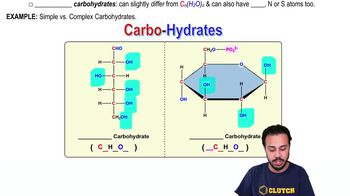
A carbon-based molecule with multiple hydroxyl groups, serving as a primary energy source and structural component in cells.
Track progress
Control buttons has been changed to "navigation" mode.
1/15
Related flashcards
Related practice
Recommended videos
Carbohydrates quiz
Carbohydrates
15 Terms
Carbohydrates
5. Molecules of Microbiology
4 problems
Topic
Nicole
Proteins
5. Molecules of Microbiology
4 problems
Topic
Nicole
5. Molecules of Microbiology
8 topics
14 problems
Chapter
Nicole
03:08
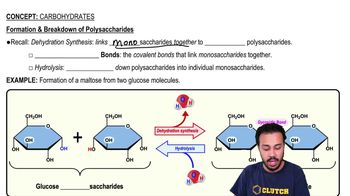
Formation & Breakdown of Polysaccharides
25038
views
420
rank
04:53
Carbohydrates
32601
views
522
rank
04:48
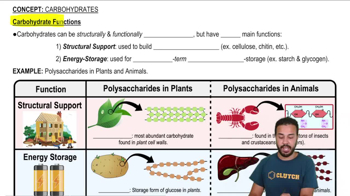
Carbohydrate Functions
24030
views
355
rank
Terms in this set (15)
Hide definitions
Carbohydrate
A carbon-based molecule with multiple hydroxyl groups, serving as a primary energy source and structural component in cells.
Saccharide
A sugar unit, ranging from single molecules to long chains, forming the basic building blocks of carbohydrates.
Monosaccharide
A single sugar unit acting as the monomer for larger carbohydrate structures, exemplified by glucose.
Oligosaccharide
A carbohydrate composed of 2 to 20 covalently linked monosaccharide units, often involved in cell recognition.
Polysaccharide
A polymer consisting of more than 20 monosaccharide units, serving roles in energy storage and structural support.
Glucose
The most abundant simple sugar, following the formula C6H12O6, and a key energy source for cells.
Glycosidic Bond
A covalent linkage formed between monosaccharide units during the synthesis of larger carbohydrate molecules.
Dehydration Synthesis
A process that joins monosaccharides by removing a water molecule, resulting in the formation of larger carbohydrates.
Hydrolysis
A reaction that splits polysaccharides into monosaccharides by adding water, facilitating carbohydrate breakdown.
Cellulose
A structural polysaccharide found in plant cell walls, providing rigidity and support to plant cells.
Chitin
A structural polysaccharide present in the exoskeletons of insects and crustaceans, offering protection and support.
Starch
A storage polysaccharide in plants, composed of glucose units, serving as an energy reserve.
Glycogen
A storage polysaccharide in animals, primarily found in the liver and muscles, storing glucose for energy.
Hydroxyl Group
A functional group consisting of an oxygen and hydrogen atom, abundant in carbohydrate structures.
Energy Storage
A primary function of certain carbohydrates, allowing organisms to retain and mobilize glucose as needed.
 BackBack
 03:08
03:08