Skip to main content
Microbiology
My Course
Learn
Exam Prep
AI Tutor
Study Guides
Textbook Solutions
Flashcards
Explore
Try the app
My Course
Learn
Exam Prep
AI Tutor
Study Guides
Textbook Solutions
Flashcards
Explore
Try the app
Back
Carbon quiz
You can tap to flip the card.
What is the most abundant element in living systems, excluding water?
You can tap to flip the card.
👆
What is the most abundant element in living systems, excluding water?
Carbon is the most abundant element in living systems when water is excluded.
Track progress
Control buttons has been changed to "navigation" mode.
1/15
Related flashcards
Related practice
Recommended videos
Carbon definitions
Carbon
14 Terms
Carbon
5. Molecules of Microbiology
5 problems
Topic
Nicole
Functional Groups
5. Molecules of Microbiology
3 problems
Topic
Brendan
5. Molecules of Microbiology
8 topics
14 problems
Chapter
Nicole
03:35
Carbon is an Excellent Building Block
22946
views
911
rank
04:19
Carbon
30204
views
714
rank
Terms in this set (15)
Hide definitions
What is the most abundant element in living systems, excluding water?
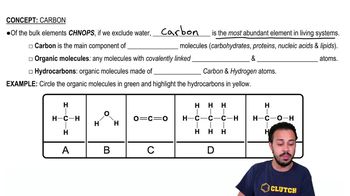
Carbon is the most abundant element in living systems when water is excluded.
What are the four main classes of organic molecules in living organisms?
The four main classes are carbohydrates, proteins, nucleic acids, and lipids.
What defines an organic molecule?
An organic molecule contains covalently linked carbon and hydrogen atoms.
What is a hydrocarbon?
A hydrocarbon is an organic molecule made up only of carbon and hydrogen atoms.
Why is water (H2O) not considered an organic molecule?
Water lacks covalently linked carbon and hydrogen atoms, so it is not organic.
Why is carbon dioxide (CO2) not classified as an organic molecule?
CO2 does not have covalently linked carbon and hydrogen atoms.
What makes carbon a versatile atomic building block?
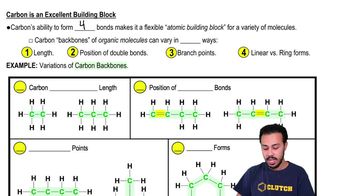
Carbon can form four covalent bonds, allowing for a variety of molecular structures.
List the four ways carbon backbones can vary in organic molecules.
They can vary in length, position of double bonds, presence of branch points, and whether they are linear or ring-shaped.
How does the length of a carbon backbone affect organic molecules?
Different molecules can have carbon backbones of varying lengths, affecting their structure and function.
How can the position of double bonds in a carbon backbone vary?
Double bonds can occur between different pairs of carbon atoms within the backbone.
What is a branched carbon backbone?
A branched carbon backbone has one or more carbon atoms branching off the main chain.
What is the difference between linear and ring forms of carbon backbones?
Linear forms are straight chains, while ring forms are closed loops of carbon atoms.
Can ring forms of carbon backbones contain double bonds?
Yes, ring forms can also have double bonds within the ring structure.
Why are hydrocarbons highlighted as a subset of organic molecules?
Because they consist only of carbon and hydrogen, distinguishing them from other organic molecules that may contain additional elements.
What is the main takeaway about carbon's role in biological molecules?
Carbon's ability to form diverse structures makes it the essential backbone for the variety of organic molecules in living systems.
 BackBack
 03:35
03:35