Back

Cell Inclusions quiz

Control buttons has been changed to "navigation" mode.
1/15
  • What are cell inclusions?

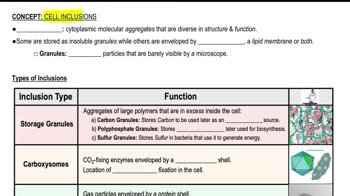
    Cell inclusions are cytoplasmic molecular aggregates with diverse structures and functions found within the cell.
  • How are some cell inclusions stored within the cell?

    Some cell inclusions are stored as insoluble granules, while others are enveloped by proteins, a lipid membrane, or both.
  • What is the main function of storage granules in cells?

    Storage granules store excess large polymers that the cell can use later when needed.
  • What do carbon granules store and why?

    Carbon granules store carbon, which can be used later as an energy source by the cell.
  • What is stored in polyphosphate granules and for what purpose?

    Polyphosphate granules store inorganic phosphate groups for later use in biosynthesis, such as making nucleotides.
  • Which type of bacteria use sulfur granules, and for what reason?

    Sulfur granules are used by bacteria that utilize sulfur to generate energy.
  • What are carboxysomes and what is their main function?

    Carboxysomes are inclusions enveloped by a protein shell that contain CO2-fixing enzymes and serve as the site of carbon fixation in many bacteria.
  • What do gas vesicles contain and what is their role?

    Gas vesicles contain gas and help control the cell's buoyancy in aquatic environments.
  • How do gas vesicles benefit aquatic bacteria?

    They allow bacteria to adjust their position in the water column for optimal access to light and nutrients.
  • What is the difference between gas vesicles and gas vacuoles?

    Gas vesicles are individual gas-filled structures, while gas vacuoles are groups of gas vesicles that are larger in size.
  • What are magnetosomes composed of?

    Magnetosomes are intracellular chains of iron-containing molecules enclosed within a membrane.
  • What is the function of magnetosomes in bacteria?

    Magnetosomes help bacteria orient themselves with the Earth's magnetic field for directional awareness.
  • How do storage granules help cells during nutrient scarcity?

    Cells can break down storage granules to access stored molecules when external supplies are low.
  • What structural feature do carboxysomes and gas vesicles share?

    Both carboxysomes and gas vesicles are enveloped by a protein shell.
  • Why are cell inclusions important for bacterial survival?

    Cell inclusions allow bacteria to store nutrients, control buoyancy, fix carbon, and orient themselves, enhancing their adaptability and survival.