Back

Cell Junctions quiz

Control buttons has been changed to "navigation" mode.
1/15
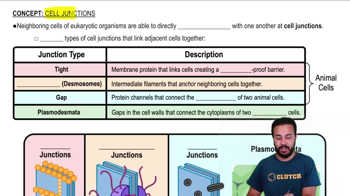
  • What are the four main types of cell junctions that link adjacent eukaryotic cells?

    The four main types are tight junctions, anchoring junctions (desmosomes), gap junctions, and plasmodesmata.
  • What is the primary function of tight junctions between animal cells?

    Tight junctions create leak-proof barriers between cells, preventing substances like liquids from seeping through.
  • Which cell junction uses intermediate filaments to mechanically link neighboring cells?

    Anchoring junctions, also known as desmosomes, use intermediate filaments to link neighboring cells together.
  • Are anchoring junctions leak-proof like tight junctions?

    No, anchoring junctions are not leak-proof; substances can still seep between cells.
  • What type of cell junction forms protein channels that connect the cytoplasm of two animal cells?

    Gap junctions form protein channels that connect the cytoplasm of two animal cells, allowing exchange of materials.
  • Which cell junction is exclusive to plant cells and allows exchange of materials between them?

    Plasmodesmata are exclusive to plant cells and allow exchange of materials between neighboring plant cells.
  • How do plasmodesmata function similarly to gap junctions?

    Both plasmodesmata and gap junctions create direct connections between the cytoplasm of adjacent cells for material exchange.
  • Which three types of cell junctions are found only in animal cells?

    Tight junctions, anchoring junctions (desmosomes), and gap junctions are found only in animal cells.
  • What prevents lemonade from leaking between your cells when you drink it?

    Tight junctions prevent liquids like lemonade from leaking between your cells.
  • What are the complex protein structures in anchoring junctions made of?

    They are made of intermediate filaments.
  • What do the protein channels in gap junctions allow to pass between cells?

    They allow the exchange of nutrients and other substances between neighboring cells.
  • Where are plasmodesmata located in plant cells?

    Plasmodesmata are located as gaps in the cell walls of plant cells.
  • What is the main difference between tight junctions and anchoring junctions?

    Tight junctions are leak-proof, while anchoring junctions are not.
  • What do the gray circles in the tight junction diagram represent?

    They represent proteins that tightly link two cells together to create a leak-proof barrier.
  • Why are plasmodesmata important for plant cells?

    Plasmodesmata allow plant cells to exchange nutrients and other materials directly through their cell walls.