Back

Central Dogma quiz

Control buttons has been changed to "navigation" mode.
1/15
  • What does the central dogma of biology describe?

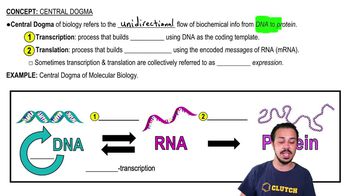
    It describes the unidirectional flow of biochemical information from DNA to protein.
  • What is meant by 'unidirectional' in the context of the central dogma?

    It means information flows in one direction, from DNA to protein, and cannot go backwards from protein to DNA.
  • What are the two main steps in the central dogma?

    The two main steps are transcription and translation.
  • What happens during transcription?

    RNA is synthesized from a DNA template during transcription.
  • What type of RNA is specifically produced during transcription?

    Messenger RNA (mRNA) is specifically produced during transcription.
  • What is the role of mRNA in the central dogma?

    mRNA carries the encoded message from DNA to be used in protein synthesis during translation.
  • What occurs during translation?

    Proteins are synthesized from the encoded messages in mRNA during translation.
  • What is gene expression?

    Gene expression refers to the combined processes of transcription and translation, resulting in the production of a gene's final product, usually a protein.
  • What is DNA replication?

    DNA replication is the process of synthesizing new DNA from a DNA template.
  • What is reverse transcription?

    Reverse transcription is the process of synthesizing DNA from an RNA template.
  • Can information flow from protein back to nucleic acids according to the central dogma?

    No, the flow of information from protein to nucleic acids is not possible; it is irreversible.
  • What are nucleic acids in the context of the central dogma?

    Nucleic acids refer to DNA and RNA.
  • Is the process of translation reversible?

    No, translation is irreversible; once protein is made, its information cannot be used to make nucleic acids.
  • What is the final product of gene expression in most cases?

    The final product is typically a protein.
  • Why is the central dogma important in molecular biology?

    It explains how genetic information is transferred from DNA to protein, guiding the understanding of gene expression and cellular function.