Back

Chemiosmosis definitions

Control buttons has been changed to "navigation" mode.
1/15
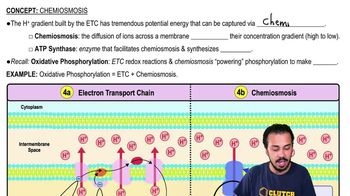
  • Chemiosmosis

    Diffusion of ions across a semipermeable membrane, harnessing a concentration gradient to drive ATP synthesis.
  • Hydrogen Ion Concentration Gradient

    Difference in hydrogen ion levels across a membrane, storing potential energy used for ATP production.
  • Electron Transport Chain

    Series of protein complexes transferring electrons to create a proton gradient and facilitate ATP generation.
  • ATP Synthase

    Membrane-embedded enzyme that uses ion flow to catalyze the formation of ATP from ADP and phosphate.
  • Oxidative Phosphorylation

    Process coupling electron transport and chemiosmosis to produce the majority of cellular ATP.
  • Adenosine Triphosphate

    Primary energy carrier molecule produced during cellular respiration, fueling cellular activities.
  • Adenosine Diphosphate

    Molecule phosphorylated to form ATP, serving as a substrate for energy storage.
  • Redox Reactions

    Electron transfer processes that drive the creation of a proton gradient in cellular respiration.
  • Intermembrane Space

    Region between mitochondrial membranes where hydrogen ions accumulate during electron transport.
  • Mitochondrial Matrix

    Innermost compartment of mitochondria, site of lower hydrogen ion concentration during chemiosmosis.
  • Aerobic Cellular Respiration

    Oxygen-dependent metabolic pathway generating ATP through electron transport and chemiosmosis.
  • Semipermeable Membrane

    Barrier allowing selective passage of ions, crucial for maintaining concentration gradients.
  • Electron Carriers

    Molecules like NADH and FADH2 that donate electrons to the electron transport chain.
  • Phosphorylation

    Addition of a phosphate group to ADP, resulting in ATP formation during energy metabolism.
  • Potential Energy

    Stored energy in the form of ion gradients, harnessed for ATP synthesis in mitochondria.