Chemotaxis quiz #1 Flashcards
You can tap to flip the card.
Control buttons has been changed to "navigation" mode.
1/10
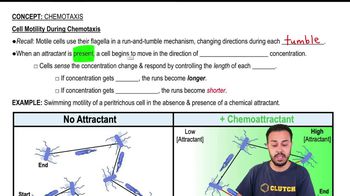
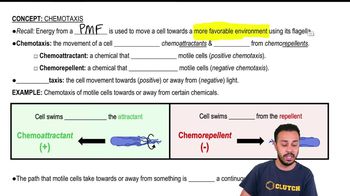
A bacterial cell exhibiting chemotaxis probably has which cellular structure?A bacterial cell exhibiting chemotaxis probably has flagella, which enable movement through runs and tumbles toward or away from chemical stimuli.What is the difference between positive and negative chemotaxis?Positive chemotaxis is movement toward a chemoattractant, while negative chemotaxis is movement away from a chemorepellant.How does phototaxis differ from chemotaxis?Phototaxis is a type of chemotaxis where cells move toward or away from light, rather than chemical stimuli.What powers the movement of bacterial flagella during chemotaxis?The movement of bacterial flagella during chemotaxis is powered by the proton motive force (PMF).Describe the pattern of movement a motile cell uses during chemotaxis.Motile cells move in a series of 'runs' (straight movement) and 'tumbles' (directional changes) rather than in a straight line.How do cells adjust their movement when sensing changes in chemoattractant concentration?Cells lengthen their runs in low concentrations and shorten them as they approach higher concentrations of chemoattractant.What is the net movement of a cell in the absence of a chemoattractant?In the absence of a chemoattractant, cells show no net movement and end up near their starting position.What does the term 'paratricous' refer to in bacterial motility?'Paratricous' refers to the distribution of flagella all over the surface of a bacterial cell.What happens to a cell's movement when it encounters a chemorepellant?When a cell encounters a chemorepellant, it exhibits negative chemotaxis and moves away from the repellent.How do cells sense and respond to chemical gradients during chemotaxis?Cells use complex mechanisms to detect changes in chemical concentration and adjust the length of their runs accordingly.