Skip to main content
Microbiology
My Course
Learn
Exam Prep
AI Tutor
Study Guides
Textbook Solutions
Flashcards
Explore
Try the app
My Course
Learn
Exam Prep
AI Tutor
Study Guides
Textbook Solutions
Flashcards
Explore
Try the app
Back
Conjunctivitis definitions
You can tap to flip the card.
Conjunctiva
You can tap to flip the card.
👆
Conjunctiva
Thin mucous membrane covering the front of the eye and lining the inside of the eyelids, prone to infection due to exposure and vascularization.
Track progress
Control buttons has been changed to "navigation" mode.
1/14
Related flashcards
Related practice
Recommended videos
Conjunctivitis quiz
Conjunctivitis
15 Terms
Conjunctivitis
29. Microbial Infections - Skin and Eyes
4 problems
Topic
Trachoma
29. Microbial Infections - Skin and Eyes
4 problems
Topic
29. Microbial Infections - Skin and Eyes - Part 1 of 2
4 topics
8 problems
Chapter
29. Microbial Infections - Skin and Eyes - Part 2 of 2
1 topic
2 problems
Chapter
03:07
Conjunctivitis
198
views
2
rank
Terms in this set (14)
Hide definitions
Conjunctiva
Thin mucous membrane covering the front of the eye and lining the inside of the eyelids, prone to infection due to exposure and vascularization.
Conjunctivitis
Inflammatory condition of the conjunctiva, often contagious, causing discomfort and potential complications if untreated.
Adenoviruses
Common viral agents responsible for respiratory infections and the majority of viral conjunctivitis cases.
Herpesviruses
Less common viral cause of conjunctival inflammation, distinct from types causing sexually transmitted infections.
Haemophilus influenzae
Primary bacterial species implicated in bacterial conjunctivitis, leading to mucopurulent eye discharge.
Pseudomonads
Group of bacteria occasionally responsible for bacterial conjunctivitis, known for their environmental resilience.
Watery Discharge
Clear fluid from the eye, characteristic of viral conjunctivitis, not causing eyelids to stick together.
Mucopurulent Discharge
Thick, pus-like eye secretion, often green or yellow, typical of bacterial conjunctivitis and may cause eyelids to stick.
Antibacterial Eye Drops
Topical medication used to treat bacterial conjunctivitis by targeting causative bacteria.
Supportive Care
Symptom-relief approach for viral conjunctivitis, as specific antiviral treatments are unavailable.
Contagiousness
High potential for transmission, making conjunctivitis a significant public health concern in communal settings.
Ocular Complications
Potential adverse outcomes from untreated conjunctivitis, emphasizing the need for timely management.
Blood Vessels
Structures within the conjunctiva contributing to its vulnerability to inflammation and infection.
Eyelid Adhesion
Phenomenon where eyelids stick together, especially after sleep, commonly seen in bacterial conjunctivitis.
 BackBack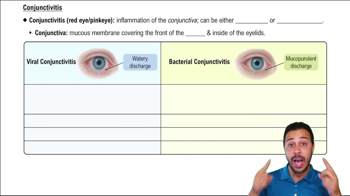
 03:07
03:07