Skip to main content
Microbiology
My Course
Learn
Exam Prep
AI Tutor
Study Guides
Textbook Solutions
Flashcards
Explore
Try the app
My Course
Learn
Exam Prep
AI Tutor
Study Guides
Textbook Solutions
Flashcards
Explore
Try the app
Back
Covalent Bonds definitions
You can tap to flip the card.
Covalent Bond
You can tap to flip the card.
👆
Covalent Bond
An interaction between two atoms resulting from the sharing of electrons, forming a stable connection.
Track progress
Control buttons has been changed to "navigation" mode.
1/15
Related flashcards
Related practice
Recommended videos
Covalent Bonds quiz
Covalent Bonds
15 Terms
Covalent Bonds
3. Chemical Principles of Microbiology
4 problems
Topic
Monica
Noncovalent Bonds
3. Chemical Principles of Microbiology
3 problems
Topic
Monica
3. Chemical Principles of Microbiology
7 topics
12 problems
Chapter
Nicole
04:28
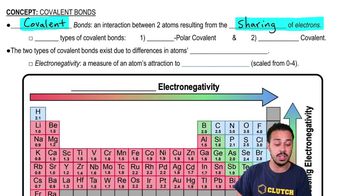
Covalent Bonds
28057
views
548
rank
06:51
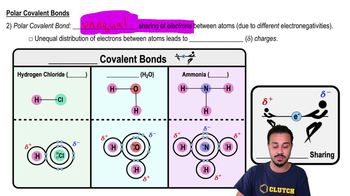
Polar Covalent Bonds
22199
views
372
rank
06:41
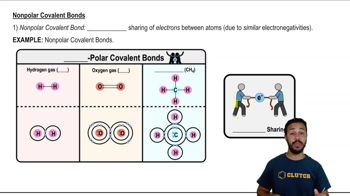
Nonpolar Covalent Bonds
23335
views
428
rank
Terms in this set (15)
Hide definitions
Covalent Bond
An interaction between two atoms resulting from the sharing of electrons, forming a stable connection.
Electron Sharing
A process where atoms distribute electrons between them, leading to bond formation and molecular stability.
Nonpolar Covalent Bond
A connection where atoms share electrons equally due to similar or identical electronegativities.
Polar Covalent Bond
A connection where atoms share electrons unequally, resulting in partial charges due to differing electronegativities.
Electronegativity
A measure of how strongly an atom attracts electrons, ranging from 0 (weak) to 4 (strong).
Partial Charge
A slight electrical charge on an atom within a molecule, arising from unequal electron distribution.
Periodic Table
An arrangement of elements showing trends in properties like electronegativity across periods and groups.
Hydrogen Gas
A molecule consisting of two hydrogen atoms sharing electrons equally, forming a nonpolar covalent bond.
Oxygen Gas
A molecule made of two oxygen atoms with identical electronegativities, resulting in equal electron sharing.
Methane
A molecule with one carbon and four hydrogen atoms, where similar electronegativities lead to nonpolar bonds.
Hydrogen Chloride
A molecule with hydrogen and chlorine atoms, where chlorine's higher electronegativity causes a polar bond.
Water Molecule
A molecule with one oxygen and two hydrogen atoms, where oxygen's high electronegativity creates partial charges.
Ammonia
A molecule with one nitrogen and three hydrogen atoms, where nitrogen's higher electronegativity leads to polarity.
Double Bond
A connection involving two pairs of shared electrons, often seen between identical atoms like oxygen.
Single Bond
A connection involving one pair of shared electrons, commonly found in molecules like hydrogen gas.
 BackBack
 04:28
04:28