What does CRISPR stand for in the CRISPR Cas system?
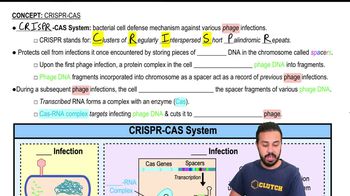
CRISPR stands for clusters of regularly interspaced short palindromic repeats.
What is the primary function of the CRISPR Cas system in bacteria?
The CRISPR Cas system acts as a defense mechanism against phage infections.
What are spacers in the context of the CRISPR Cas system?
Spacers are small fragments of phage DNA stored in the bacterial chromosome as a record of past infections.
How are spacers incorporated into the bacterial chromosome?
Upon initial phage infection, phage DNA is degraded into fragments, which can be incorporated into the chromosome as spacers.
What happens during a subsequent phage infection in a bacterium with the CRISPR Cas system?
The cell transcribes spacer fragments into RNA, which forms a complex with the Cas enzyme to target and cleave incoming phage DNA.
What is the role of the Cas enzyme in the CRISPR Cas system?
The Cas enzyme forms a complex with RNA and cleaves the phage DNA, inactivating the phage.
How does the CRISPR Cas system provide inherited immunity?
Because the CRISPR system is part of the chromosome, it can be passed down to future generations, providing inherited immunity against specific phages.
What does the RNA in the Cas-RNA complex do?
The RNA acts as a guide, being complementary to the phage DNA sequence and directing the Cas enzyme to the target.
What is the result of the Cas enzyme cleaving phage DNA?
The phage DNA is degraded and the phage is inactivated, protecting the bacterial cell.
Why are spacers considered a record of previous phage infections?
Each spacer is a fragment of phage DNA from a past infection, allowing the cell to recognize and defend against the same phage in the future.
What triggers the transcription of spacers in the CRISPR Cas system?
A subsequent infection by the same or similar phage triggers the transcription of spacers.
How does the CRISPR Cas system protect against multiple infections by the same phage?
It uses stored spacers to recognize and inactivate the phage DNA during subsequent infections.
Where is the CRISPR Cas system located within the bacterial cell?
It is located in a specific region of the bacterial chromosome.
What happens to the CRISPR Cas system when bacteria reproduce?
The CRISPR Cas system is replicated and passed down to daughter cells, maintaining immunity.
What is the significance of the palindromic repeats in CRISPR?
The palindromic repeats separate the spacers and help organize the CRISPR region in the chromosome.
 Back
Back
 07:43
07:43