Skip to main content
Microbiology
My Course
Learn
Exam Prep
AI Tutor
Study Guides
Textbook Solutions
Flashcards
Explore
Try the app
My Course
Learn
Exam Prep
AI Tutor
Study Guides
Textbook Solutions
Flashcards
Explore
Try the app
Back
Diphtheria definitions
You can tap to flip the card.
Corynebacterium diphtheriae
You can tap to flip the card.
👆
Corynebacterium diphtheriae
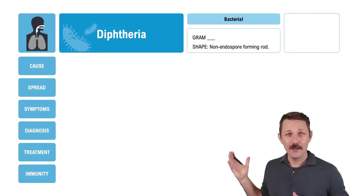
Gram-positive, non-endospore-forming, club-shaped rod responsible for a severe upper respiratory infection.
Track progress
Control buttons has been changed to "navigation" mode.
1/15
Related flashcards
Related practice
Recommended videos
Diphtheria quiz
Diphtheria
15 Terms
Diphtheria
30. Microbial Infections - Respiratory System
5 problems
Topic
Tuberculosis
30. Microbial Infections - Respiratory System
4 problems
Topic
30. Microbial Infections - Respiratory System
3 topics
7 problems
Chapter
Guided course
03:53
Diphtheria Example 1
208
views
4
rank
Guided course
07:05
Diptheria
308
views
9
rank
Terms in this set (15)
Hide definitions
Corynebacterium diphtheriae
Gram-positive, non-endospore-forming, club-shaped rod responsible for a severe upper respiratory infection.
Exotoxin
Potent protein produced only when bacteria are lysogenized by a phage, inhibiting host protein synthesis.
Bacteriophage
Virus that infects bacteria, introducing genes necessary for toxin production in certain pathogens.
Lysogeny
State where a phage integrates its genetic material into a bacterial genome, enabling toxin gene expression.
Pseudomembrane
Thick layer of fibrin and dead cells in the airway, potentially causing obstruction and suffocation.
Gram-positive
Bacterial classification indicating a thick peptidoglycan cell wall, retaining crystal violet stain.
Club shape
Distinctive bacterial morphology with rods that have swollen ends, resembling a bat or club.
Respiratory droplets
Primary transmission route involving tiny fluid particles expelled during coughing or sneezing.
Bull neck
Swelling of the neck due to severe inflammation, often seen in advanced upper respiratory infections.
Bacterial culture
Laboratory method using selective and differential media to grow and identify specific pathogens.
Immunoassay
Diagnostic technique using antibodies to detect the presence of specific bacterial toxins.
PCR
Molecular method amplifying DNA sequences to confirm the presence of toxin genes.
Antitoxin
Therapeutic agent administered to neutralize circulating bacterial toxins in the body.
DTaP vaccine
Pediatric immunization containing diphtheria toxoid, providing protection against the bacterial toxin.
Toxoid vaccine
Immunization strategy using inactivated toxins to elicit immunity without causing disease.
 BackBack
 03:53
03:53