Skip to main content
Microbiology
My Course
Learn
Exam Prep
AI Tutor
Study Guides
Textbook Solutions
Flashcards
Explore
Try the app
My Course
Learn
Exam Prep
AI Tutor
Study Guides
Textbook Solutions
Flashcards
Explore
Try the app
Back
DNA Polymerases quiz
You can tap to flip the card.
What is the primary function of DNA polymerases?
You can tap to flip the card.
👆
What is the primary function of DNA polymerases?
DNA polymerases are enzymes responsible for synthesizing new DNA strands during DNA replication.
Track progress
Control buttons has been changed to "navigation" mode.
1/15
Related flashcards
Related practice
Recommended videos
DNA Polymerases definitions
DNA Polymerases
15 Terms
DNA Polymerases
14. DNA Replication
3 problems
Topic
Brendan
Leading & Lagging DNA Strands
14. DNA Replication
3 problems
Topic
Brendan
14. DNA Replication
10 topics
14 problems
Chapter
Brendan
03:47
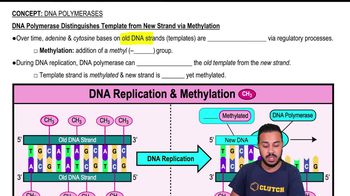
DNA Polymerase Distinguishes Template from New Strand via Methylation
2396
views
25
rank
05:03
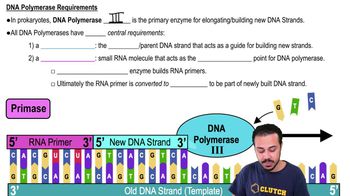
DNA Polymerases Requirements
13203
views
239
rank
04:01
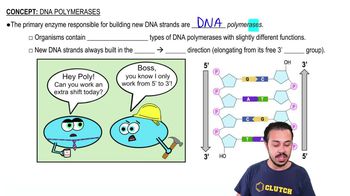
DNA Polymerases
13833
views
217
rank
Terms in this set (15)
Hide definitions
What is the primary function of DNA polymerases?
DNA polymerases are enzymes responsible for synthesizing new DNA strands during DNA replication.
In which direction do DNA polymerases synthesize new DNA strands?
DNA polymerases always build new DNA strands in the 5' to 3' direction.
What two things are required for DNA polymerases to begin DNA synthesis?
DNA polymerases require a template strand and a primer to initiate DNA synthesis.
Which enzyme provides the primer needed for DNA polymerase to start synthesis?
The enzyme primase synthesizes the RNA primer required for DNA polymerase to begin DNA synthesis.
What is the role of the primer in DNA replication?
The primer provides a free 3' hydroxyl group that DNA polymerase needs to elongate the new DNA strand.
Which DNA polymerase is primarily responsible for elongating new DNA strands in prokaryotes?
DNA Polymerase III is the main enzyme responsible for elongating new DNA strands in prokaryotes.
What is the function of DNA Polymerase I during DNA replication?
DNA Polymerase I replaces the RNA primers with DNA on the newly synthesized strand.
How do DNA polymerases distinguish between the old and new DNA strands?
DNA polymerases distinguish old and new DNA strands based on methylation; old strands are methylated, while new strands are initially unmethylated.
Which bases are most commonly methylated on the old DNA template strand?
Cytosine and adenine residues are the bases most commonly methylated on the old DNA template strand.
Why can't DNA polymerase start synthesizing a new DNA strand from scratch?
DNA polymerase cannot start from scratch because it requires a free 3' hydroxyl group provided by a primer to add new nucleotides.
What does the term 'anti-parallel' mean in the context of DNA structure?
Anti-parallel means that the two DNA strands run in opposite directions, with one strand oriented 5' to 3' and the other 3' to 5'.
What functional group is found at the 3' end of a DNA strand?
A free hydroxyl (OH) group is found at the 3' end of a DNA strand.
What functional group is found at the 5' end of a DNA strand?
A free phosphate group is found at the 5' end of a DNA strand.
What is methylation, and what group is added during this process?
Methylation is the addition of a methyl group (CH3) to DNA bases, typically cytosine or adenine.
After DNA replication, what happens to the methylation status of the new DNA strand?
The new DNA strand is initially unmethylated but will become methylated over time.
 BackBack
 03:47
03:47