Skip to main content
Microbiology
My Course
Learn
Exam Prep
AI Tutor
Study Guides
Textbook Solutions
Flashcards
Explore
Try the app
My Course
Learn
Exam Prep
AI Tutor
Study Guides
Textbook Solutions
Flashcards
Explore
Try the app
Back
DNA Repair definitions
You can tap to flip the card.
DNA Replication
You can tap to flip the card.
👆
DNA Replication
Process by which genetic material is copied, occasionally introducing base pairing errors that may require correction.
Track progress
Control buttons has been changed to "navigation" mode.
1/15
Related flashcards
Related practice
Recommended videos
DNA Repair quiz
DNA Repair
15 Terms
DNA Repair
14. DNA Replication
3 problems
Topic
Nicole
Steps of DNA Replication
14. DNA Replication
4 problems
Topic
Brendan
14. DNA Replication
10 topics
14 problems
Chapter
Brendan
03:20
DNA Repair
13248
views
151
rank
02:12
DNA Proofreading & Repair Enzymes
12756
views
106
rank
2
comments
Terms in this set (15)
Hide definitions
DNA Replication
Process by which genetic material is copied, occasionally introducing base pairing errors that may require correction.
Base Pairing Error
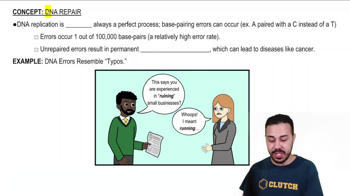
Mismatched nucleotides during copying, such as adenine pairing with cytosine instead of thymine.
Mutation
Permanent change in genetic sequence, often resulting from unrepaired replication errors, potentially causing disease.
Cancer
Disease that can arise from accumulated genetic changes due to unrepaired DNA errors.
DNA Polymerase
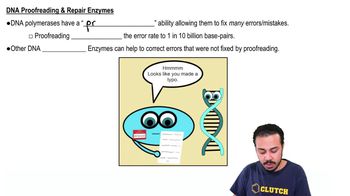
Enzyme responsible for synthesizing new DNA strands and correcting many replication mistakes through proofreading.
Proofreading Ability
Mechanism by which certain enzymes detect and correct errors during DNA synthesis, greatly reducing mutation rates.
Error Rate
Frequency at which mistakes occur during DNA copying, dramatically lowered by enzymatic correction mechanisms.
DNA Repair Enzyme
Protein that identifies and fixes genetic mistakes not corrected during initial DNA synthesis.
Fidelity
Accuracy of genetic information transfer during replication, maintained by error correction systems.
Thymine
Nucleotide base that normally pairs with adenine in DNA, with mispairing leading to replication errors.
Adenine
Nucleotide base that should pair with thymine, with incorrect pairing causing genetic mistakes.
Cytosine
Nucleotide base that can be incorrectly paired with adenine during replication, resulting in errors.
Resume Analogy
Comparison illustrating how small genetic errors can significantly alter biological outcomes, similar to typos affecting job prospects.
Genetic Sequence
Order of nucleotides in DNA, where even minor changes can have major biological consequences.
Enzyme
Biological catalyst, such as those involved in DNA synthesis and repair, ensuring genetic accuracy.
 BackBack
 03:20
03:20