Skip to main content
Microbiology
My Course
Learn
Exam Prep
AI Tutor
Study Guides
Textbook Solutions
Flashcards
Explore
Try the app
My Course
Learn
Exam Prep
AI Tutor
Study Guides
Textbook Solutions
Flashcards
Explore
Try the app
Back
DNA Repair quiz
You can tap to flip the card.
What is a base pairing error in DNA replication?
You can tap to flip the card.
👆
What is a base pairing error in DNA replication?
A base pairing error occurs when the wrong nucleotide is paired, such as adenine pairing with cytosine instead of thymine.
Track progress
Control buttons has been changed to "navigation" mode.
1/15
Related flashcards
Related practice
Recommended videos
DNA Repair definitions
DNA Repair
15 Terms
DNA Repair
14. DNA Replication
3 problems
Topic
Nicole
Steps of DNA Replication
14. DNA Replication
4 problems
Topic
Brendan
14. DNA Replication
10 topics
14 problems
Chapter
Brendan
03:20
DNA Repair
13247
views
151
rank
02:12
DNA Proofreading & Repair Enzymes
12754
views
106
rank
2
comments
Terms in this set (15)
Hide definitions
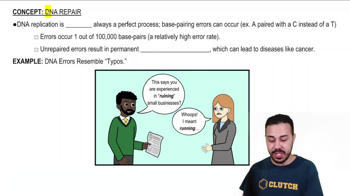
What is a base pairing error in DNA replication?
A base pairing error occurs when the wrong nucleotide is paired, such as adenine pairing with cytosine instead of thymine.
How often do base pairing errors occur during DNA replication?
Base pairing errors occur at a rate of about 1 in every 100,000 base pairs.
What can happen if DNA replication errors are not repaired?
Unrepaired errors can become permanent mutations, which may lead to diseases like cancer.
How are mutations compared to typos in a resume?
Mutations are like typos in a resume because they can significantly change the intended message or outcome.
What is the normal base pairing for adenine in DNA?
Adenine normally pairs with thymine in DNA.
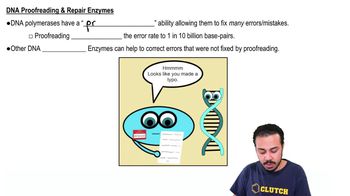
What is the proofreading ability of DNA polymerases?
DNA polymerases can find and fix many errors that occur during DNA replication, reducing the error rate.
How much does DNA polymerase proofreading reduce the error rate?
Proofreading reduces the error rate from 1 in 100,000 to 1 in 10,000,000,000 base pairs.
Are mutations still possible after DNA polymerase proofreading?
Yes, mutations are still possible, but they are much less likely after proofreading.
What role do other DNA repair enzymes play?
Other DNA repair enzymes help correct errors that DNA polymerase proofreading might miss.
Why is a 1 in 100,000 error rate considered high?
It's considered high because DNA replication happens frequently and involves large amounts of DNA.
What is the consequence of a mutation in DNA?
A mutation can change the final product encoded by the DNA, potentially leading to diseases.
What does the cartoon analogy in the lesson illustrate?
It illustrates how a small error (like a typo) can have a big impact, similar to mutations in DNA.
What is the main function of DNA repair mechanisms?
Their main function is to maintain the fidelity of DNA by correcting replication errors.
How do DNA repair enzymes complement DNA polymerase proofreading?
They fix errors that escape the proofreading process, further reducing mutation rates.
Why is DNA repair important for health?
DNA repair prevents mutations that could lead to diseases such as cancer.
 BackBack
 03:20
03:20