Skip to main content
Microbiology
My Course
Learn
Exam Prep
AI Tutor
Study Guides
Textbook Solutions
Flashcards
Explore
Try the app
My Course
Learn
Exam Prep
AI Tutor
Study Guides
Textbook Solutions
Flashcards
Explore
Try the app
Back
Electromagnetic Spectrum definitions
You can tap to flip the card.
Electromagnetic Spectrum
You can tap to flip the card.
👆
Electromagnetic Spectrum
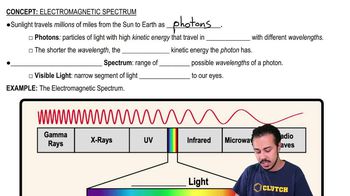
Range encompassing all possible wavelengths of light, from extremely short gamma rays to very long radio waves.
Track progress
Control buttons has been changed to "navigation" mode.
1/13
Related flashcards
Related practice
Recommended videos
Electromagnetic Spectrum quiz
Electromagnetic Spectrum
15 Terms
Electromagnetic Spectrum
13. Photosynthesis
1 problem
Topic
Nicole
Pigments of Photosynthesis
13. Photosynthesis
4 problems
Topic
Brendan
13. Photosynthesis
9 topics
13 problems
Chapter
Nicole
04:29
Electromagnetic Spectrum
12967
views
140
rank
Terms in this set (13)
Hide definitions
Electromagnetic Spectrum
Range encompassing all possible wavelengths of light, from extremely short gamma rays to very long radio waves.
Photon
Particle of light carrying kinetic energy, capable of traveling vast distances and varying in wavelength.
Kinetic Energy
Form of energy possessed by moving particles of light, increasing as wavelength decreases.
Wavelength
Distance between consecutive peaks of a light wave, determining its energy and position in the spectrum.
Visible Light
Narrow segment of the spectrum detectable by human eyes, spanning roughly 380 to 750 nanometers.
Color
Perception created by the human eye in response to specific wavelengths within the visible light range.
Gamma Rays
Type of electromagnetic radiation with extremely short wavelengths and the highest energy.
Radio Waves
Type of electromagnetic radiation with very long wavelengths and the lowest energy.
Nanometer
Unit of measurement equal to one billionth of a meter, commonly used to express wavelengths of light.
Chloroplast
Organelle in plant cells capable of capturing energy from photons for use in cellular processes.
Energy
Capacity to do work, varying among photons based on their wavelength within the spectrum.
Sunlight
Natural source of photons traveling millions of miles to Earth, containing a broad range of wavelengths.
Human Eye
Organ capable of detecting only a small portion of the electromagnetic spectrum, perceived as visible light.
 BackBack
 04:29
04:29