Back

Enzyme Binding Factors quiz

Control buttons has been changed to "navigation" mode.
1/15
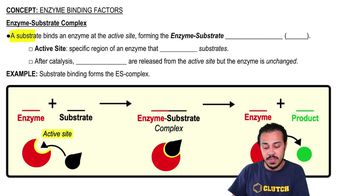
  • What is the active site of an enzyme?

    The active site is a specific region on the enzyme where the substrate binds, allowing catalysis to occur.
  • What is formed when a substrate binds to an enzyme's active site?

    The enzyme-substrate complex (ES) is formed when the substrate binds to the enzyme's active site.
  • What happens to the enzyme after catalysis is complete?

    The enzyme remains unchanged after catalysis and can catalyze additional reactions.
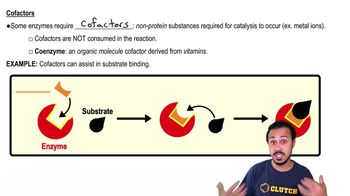
  • What are cofactors in the context of enzyme activity?

    Cofactors are non-protein substances required by some enzymes for catalysis to occur.
  • Give an example of a cofactor.

    Metal ions are an example of cofactors that some enzymes require for catalysis.
  • Are cofactors consumed during the enzymatic reaction?

    No, cofactors are not consumed in the reaction and remain unchanged.
  • What is a coenzyme?

    A coenzyme is an organic molecule cofactor, often derived from vitamins.
  • How do cofactors assist enzymes?

    Cofactors help enzymes perform catalysis, sometimes by enhancing substrate binding.
  • What abbreviation is commonly used for the enzyme-substrate complex?

    The enzyme-substrate complex is commonly abbreviated as ES.
  • What happens to the substrate during enzyme catalysis?

    The substrate is converted into product(s) during enzyme catalysis.
  • What is the abbreviation for the product in enzyme reactions?

    The product is commonly abbreviated as P.
  • Can all enzymes function without cofactors?

    No, some enzymes require cofactors to function, while others do not.
  • How can cofactors affect the enzyme's active site?

    Cofactors can modify the active site to better accommodate the substrate, enhancing binding.
  • What distinguishes a coenzyme from other cofactors?

    Coenzymes are organic molecules, while other cofactors like metal ions are not organic.
  • Why can an enzyme catalyze multiple reactions?

    Because the enzyme is unchanged after each reaction, it can catalyze the reaction repeatedly.