Back

Enzyme Inhibition definitions

Control buttons has been changed to "navigation" mode.
1/13
  • Enzyme

    A biological catalyst that accelerates chemical reactions by lowering activation energy, crucial for cellular metabolism.
  • Catalysis

    The acceleration of a chemical reaction rate, typically achieved by lowering the activation energy barrier.
  • Enzyme Inhibition

    A regulatory process where compounds decrease or halt the activity of enzymes, controlling reaction rates in cells.
  • Inhibitor

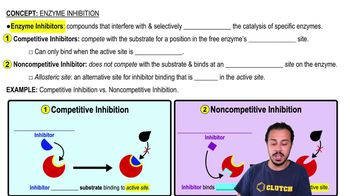
    A compound that interferes with enzyme activity, reducing or preventing the catalysis of specific reactions.
  • Competitive Inhibitor

    A molecule that resembles a substrate and occupies the active site, blocking substrate access and slowing reaction rates.
  • Noncompetitive Inhibitor

    A molecule that binds to an allosteric site, altering enzyme shape and preventing substrate binding at the active site.
  • Active Site

    A region on an enzyme where substrates bind and undergo a chemical transformation during catalysis.
  • Allosteric Site

    A location on an enzyme, distinct from the active site, where molecules can bind and induce conformational changes.
  • Substrate

    A specific reactant molecule that binds to an enzyme's active site and is transformed during a reaction.
  • Metabolic Pathway

    A series of enzyme-catalyzed reactions within a cell, regulated by mechanisms such as enzyme inhibition.
  • Regulation

    The control of enzyme activity to maintain appropriate reaction rates and cellular homeostasis.
  • Conformational Change

    A structural alteration in an enzyme, often induced by inhibitor binding, that affects its function.
  • Enzyme-Substrate Interaction

    The specific binding event between an enzyme and its substrate, essential for catalysis to occur.