Back

Enzyme Inhibition quiz

Control buttons has been changed to "navigation" mode.
1/15
  • What is the main purpose of enzyme inhibition in cells?

    Enzyme inhibition regulates the speed of chemical reactions, preventing them from proceeding too quickly.
  • What are enzyme inhibitors?

    Enzyme inhibitors are compounds that interfere with and selectively inhibit the catalysis of specific enzymes.
  • Name the two main types of enzyme inhibitors.

    The two main types are competitive inhibitors and noncompetitive inhibitors.
  • Where do competitive inhibitors bind on an enzyme?

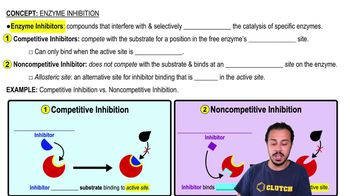
    Competitive inhibitors bind to the active site of an enzyme.
  • How do competitive inhibitors affect substrate binding?

    They block the substrate from binding to the active site by occupying it themselves.
  • What is the result of a competitive inhibitor binding to the active site?

    Catalysis is prevented and the enzyme's reaction slows down.
  • Where do noncompetitive inhibitors bind on an enzyme?

    Noncompetitive inhibitors bind to an allosteric site, which is different from the active site.
  • How do noncompetitive inhibitors affect the enzyme's active site?

    They cause the enzyme to change shape, altering the active site so the substrate cannot bind.
  • Do noncompetitive inhibitors compete with the substrate for the active site?

    No, noncompetitive inhibitors do not compete with the substrate for the active site.
  • What is an allosteric site?

    An allosteric site is an alternative binding site on an enzyme, separate from the active site.
  • What happens to catalysis when a noncompetitive inhibitor binds to an enzyme?

    Catalysis is inhibited because the substrate cannot bind to the altered active site.
  • Why are enzyme inhibitors important for metabolic pathways?

    They help regulate the speed of enzymatic reactions, ensuring proper control of metabolic pathways.
  • What does the term 'competitive' refer to in competitive inhibition?

    It refers to the inhibitor competing with the substrate for binding to the enzyme's active site.
  • How does enzyme inhibition demonstrate the importance of enzyme regulation?

    It shows that controlling enzyme activity is essential for maintaining balanced cellular reactions.
  • What is the overall effect of both competitive and noncompetitive inhibitors on enzymes?

    Both types of inhibitors slow down or inhibit enzyme activity, preventing or reducing catalysis.