Back

Eukaryotic Chromatin Modifications quiz

Control buttons has been changed to "navigation" mode.
1/15
  • What is chromatin composed of in eukaryotic cells?

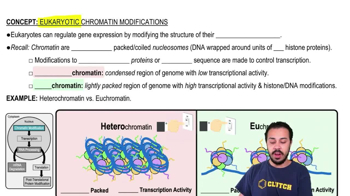
    Chromatin is composed of DNA wrapped around units of 8 histone proteins, forming nucleosomes.
  • Where do chromatin modifications take place within a eukaryotic cell?

    Chromatin modifications occur in the nucleus, where chromatin is located.
  • What is heterochromatin and how does it affect transcription?

    Heterochromatin is tightly packed chromatin with low transcriptional activity, effectively turning off gene expression.
  • How does euchromatin differ from heterochromatin in terms of structure and function?

    Euchromatin is loosely packed chromatin with high transcriptional activity, allowing genes to be turned on.
  • Why does tightly packed chromatin reduce transcriptional activity?

    Tightly packed chromatin prevents transcriptional machinery like RNA polymerase from accessing the DNA, reducing transcription.
  • What is histone acetylation?

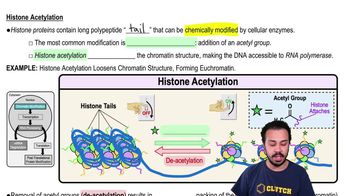
    Histone acetylation is the addition of acetyl groups to histone tails, which loosens chromatin structure and promotes transcription.
  • How does histone acetylation affect chromatin structure and gene expression?

    Histone acetylation loosens chromatin, forming euchromatin and making DNA more accessible for transcription, thus turning genes on.
  • What is the effect of removing acetyl groups from histone tails?

    Removing acetyl groups, called deacetylation, tightens chromatin structure, forming heterochromatin and reducing transcription.
  • What is DNA methylation?

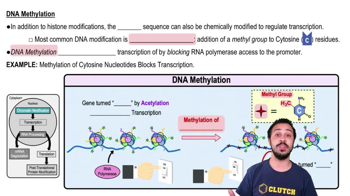
    DNA methylation is the addition of a methyl group (CH3) to cytosine nucleotides in DNA, often turning off gene expression.
  • Which nucleotide is most commonly methylated in DNA methylation?

    Cytosine is the nucleotide most commonly methylated during DNA methylation.
  • How does DNA methylation regulate gene expression?

    DNA methylation blocks RNA polymerase from accessing the promoter, preventing transcription and turning off the gene.
  • What is the main difference between histone acetylation and DNA methylation in terms of their effect on gene expression?

    Histone acetylation generally turns genes on by loosening chromatin, while DNA methylation turns genes off by blocking transcription.
  • How do acetylation and methylation provide complex gene regulation in eukaryotes?

    The interplay of acetylation and methylation allows eukaryotes to turn genes on or off depending on the type of chromatin modification.
  • What happens to transcriptional activity when chromatin is in a euchromatin state?

    Transcriptional activity is high in euchromatin because the DNA is accessible to transcriptional machinery.
  • What is the role of RNA polymerase in relation to chromatin structure?

    RNA polymerase requires loosely packed chromatin (euchromatin) to access DNA and initiate transcription.