What is observed at the end of a gel electrophoresis experiment?
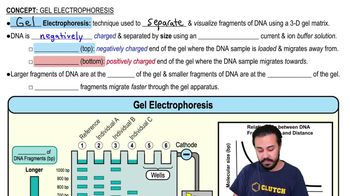
At the end of gel electrophoresis, DNA fragments are separated into distinct bands within each lane of the gel. Each band represents a DNA fragment of a specific size, with larger fragments remaining near the top and smaller fragments migrating toward the bottom. These bands can be visualized and compared to a reference DNA sample to estimate fragment sizes.
What is the answer key for a virtual gel electrophoresis lab regarding the migration of DNA fragments?
In a virtual gel electrophoresis lab, the answer key would indicate that DNA fragments are separated by size: larger fragments move slower and stay near the top of the gel, while smaller fragments move faster and travel farther toward the bottom. The reference lane is used to estimate the sizes of fragments in other lanes by comparison.
What are the main components of a standard gel apparatus used for electrophoresis?
A standard gel apparatus for electrophoresis includes a gel matrix (such as agarose), wells for loading DNA samples, lanes for separation, a cathode (negative electrode) at the top, an anode (positive electrode) at the bottom, and an ion buffer solution to conduct electricity and facilitate DNA migration.
Why does DNA migrate from the cathode to the anode during gel electrophoresis?
DNA is negatively charged and is attracted to the positively charged anode at the bottom of the gel, causing it to migrate away from the cathode.
What is the function of the wells at the top of each lane in a gel electrophoresis apparatus?
The wells serve as the starting point where DNA samples are loaded into each lane for separation.
How can a reference DNA sample be used in gel electrophoresis analysis?
A reference DNA sample of known fragment sizes allows estimation of the sizes of unknown DNA fragments in other lanes by comparison.
What does each band in a gel electrophoresis result represent?
Each band corresponds to a DNA fragment of a specific size that has migrated a certain distance through the gel.
How does the graph of DNA fragment size versus migration distance illustrate the principle of gel electrophoresis?
The graph shows that larger DNA fragments travel a shorter distance, while smaller fragments migrate farther through the gel.
Why do smaller DNA fragments move faster through the gel matrix than larger fragments?
Smaller fragments encounter less resistance in the gel matrix, allowing them to migrate more quickly toward the anode.
What role does the ion buffer solution play in gel electrophoresis?
The ion buffer solution conducts electricity and facilitates the migration of DNA fragments through the gel.