Control buttons has been changed to "navigation" mode.
1/10
Terms in this set (10)
What is generation time, and why is it important in the study of prokaryotic populations?
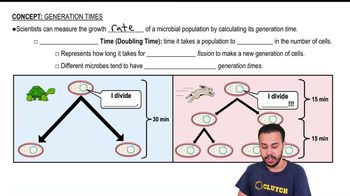
Generation time, also known as doubling time, is the amount of time required for a prokaryotic population to double in size through binary fission. It is important because it allows scientists to measure and predict microbial growth rates, which is crucial for understanding population dynamics and practical applications in microbiology.
If conditions are favorable, how does the generation time of bacteria affect their population growth?
If conditions are favorable, bacteria can have a short generation time, meaning they divide rapidly and their population size increases quickly. Faster generation times lead to more rapid population doubling and exponential growth.
What process do prokaryotic cells use to divide and create new generations?
Prokaryotic cells divide by binary fission, which produces new generations of cells.
How does the generation time of a microbe relate to the speed of binary fission?
Shorter generation times mean binary fission occurs more quickly, while longer generation times indicate slower division.
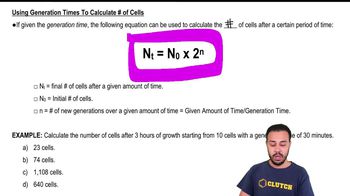
In the cell number calculation formula n_t = n_0 * 2^n, what does the variable 'n' represent?
'n' represents the number of new generations, calculated by dividing the total time by the generation time.
Why is it important to match time units when calculating the number of generations?
Matching time units ensures accurate calculation of the number of generations, as inconsistent units can lead to incorrect results.
If a microbe has a generation time of 15 minutes, how many generations will occur in 1 hour?
There will be 4 generations in 1 hour, since 60 minutes divided by 15 minutes equals 4.
What is the initial number of cells called in the cell number calculation formula?
The initial number of cells is called n_0 (n naught) in the formula.
How does the cell population change after each generation during binary fission?
The cell population doubles after each generation during binary fission.
What is the final step in calculating the number of cells after a given time using the formula?
The final step is multiplying the initial cell number by 2 raised to the power of the number of generations.