Back

Glucose's Impact on Lac Operon definitions

Control buttons has been changed to "navigation" mode.
1/15
  • Glucose

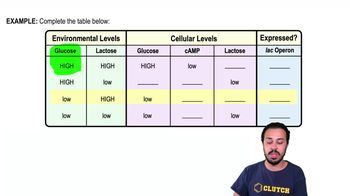
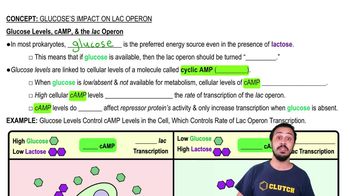
    Preferred energy source in prokaryotes; its presence keeps cAMP levels low, suppressing lac operon transcription.
  • Lactose

    Secondary energy source used when glucose is absent; its presence inactivates the lac repressor, allowing lac operon transcription.
  • Lac Operon

    A gene cluster in prokaryotes responsible for lactose metabolism, regulated by glucose and lactose availability.
  • Cyclic AMP

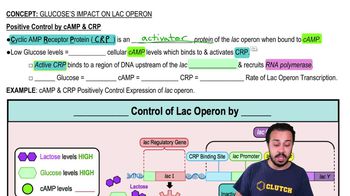
    A signaling molecule whose levels inversely correlate with glucose; high amounts enhance lac operon transcription.
  • CRP

    An activator protein that, when bound to cAMP, stimulates lac operon transcription by aiding RNA polymerase recruitment.
  • CRP Binding Site

    A DNA region upstream of the lac promoter where active CRP binds to facilitate RNA polymerase attachment.
  • RNA Polymerase

    An enzyme recruited to the lac promoter by active CRP, initiating transcription of lac operon genes.
  • Lac Repressor

    A protein that blocks lac operon transcription unless inactivated by a lactose derivative.
  • Promoter

    A DNA sequence where RNA polymerase binds to start transcription of the lac operon.
  • Positive Control

    A regulatory mechanism where activator proteins like CRP increase gene transcription rates.
  • Transcription

    The process of synthesizing RNA from the lac operon, regulated by glucose, cAMP, and CRP.
  • Gene Expression

    The overall process by which information from the lac operon is used to produce functional proteins.
  • Activator Protein

    A regulatory protein, such as CRP, that enhances transcription when bound to its effector molecule.
  • Energy Source

    A molecule like glucose or lactose used by cells to generate ATP, influencing lac operon regulation.
  • Inverse Relationship

    A regulatory pattern where high glucose results in low cAMP, and vice versa, affecting lac operon activity.