Gram-Negative Cell Walls quiz #1 Flashcards

Gram-Negative Cell Walls quiz #1
Control buttons has been changed to "navigation" mode.
1/10
  • In the figure showing diagrams of cell walls, which diagram represents a gram-negative cell wall?
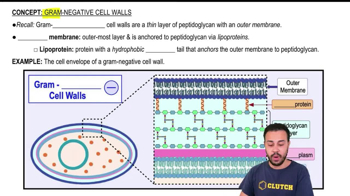
    The diagram that shows a thin peptidoglycan layer sandwiched between an inner plasma membrane and an outer membrane represents a gram-negative cell wall.
  • Which term describes a toxin that is part of the outer membrane in a gram-negative bacterial cell?
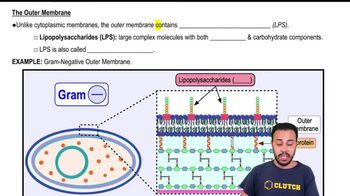
    Endotoxin (specifically, lipopolysaccharide or LPS) describes a toxin that is part of the outer membrane in a gram-negative bacterial cell.
  • Gram-negative cells contain a periplasmic space that is __________.
    Gram-negative cells contain a periplasmic space that is located between the inner plasma membrane and the outer membrane, surrounding the thin peptidoglycan layer.
  • Under a microscope, how do gram-negative bacteria appear when stained with the Gram stain?
    Gram-negative bacteria appear pink or red under a microscope after Gram staining because they do not retain the crystal violet stain and are counterstained by safranin.
  • Label the components of the cell envelope in a gram-negative cell.
    The components of the cell envelope in a gram-negative cell are: (from outside to inside) outer membrane (containing lipopolysaccharides and porins), thin peptidoglycan layer, periplasmic space, and inner plasma membrane.
  • The bottom layer of a gram-negative cell wall is made of:
    The bottom layer of a gram-negative cell wall is made of the plasma (cytoplasmic) membrane.
  • What role do lipoproteins play in the structure of gram-negative cell walls?
    Lipoproteins anchor the outer membrane to the thin peptidoglycan layer in gram-negative cell walls, helping maintain the integrity of the cell envelope.
  • Which component of lipopolysaccharide (LPS) is responsible for its toxic effects in bacterial infections?
    Lipid A is the component of LPS responsible for its toxic and damaging effects during bacterial infections.
  • How do porins facilitate molecule transport in gram-negative bacteria?
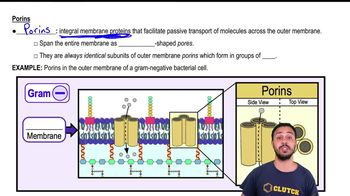
    Porins form cylindrical pores in the outer membrane, allowing passive diffusion of molecules across the membrane.
  • Why is the O antigen of LPS useful for bacterial species identification?
    The O antigen is highly variable among different species, so its structure can be used to distinguish and identify specific gram-negative bacteria.