Back

Gram-Positive Cell Walls definitions

Control buttons has been changed to "navigation" mode.
1/13
  • Gram-Positive Bacteria

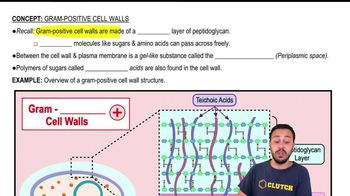
    Microorganisms with cell walls that retain crystal violet stain due to a thick peptidoglycan layer.
  • Peptidoglycan

    A rigid, thick mesh-like polymer forming the main structural component of certain bacterial cell walls.
  • Gram Stain

    A differential staining technique distinguishing bacteria based on cell wall composition.
  • Periplasm

    A gel-like region located between the cell wall and plasma membrane in certain bacteria.
  • Periplasmic Space

    The area filled with gel-like material separating the peptidoglycan layer from the plasma membrane.
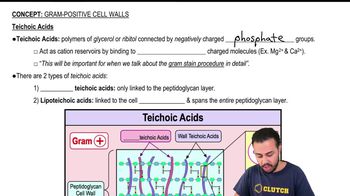
  • Teichoic Acids

    Complex sugar polymers unique to certain bacterial cell walls, often acting as cation reservoirs.
  • Wall Teichoic Acids

    Polymers attached only to the peptidoglycan layer, not extending to the cell membrane.
  • Lipoteichoic Acids

    Polymers spanning the peptidoglycan layer and anchored to the plasma membrane.
  • Glycerol

    A molecule forming part of the backbone in certain cell wall polymers, connected by phosphate groups.
  • Ribitol

    A sugar alcohol serving as a structural component in some cell wall polymers.
  • Phosphate Groups

    Negatively charged chemical groups linking sugar molecules in cell wall polymers and binding cations.
  • Cation Reservoir

    A functional region in the cell wall that binds and stores positively charged ions like magnesium and calcium.
  • Plasma Membrane

    A selectively permeable barrier beneath the cell wall, involved in anchoring certain wall polymers.