What is the difference between Gram and acid-fast stains?
Gram stain differentiates bacteria based on cell wall peptidoglycan structure, while acid-fast stain identifies bacteria with waxy cell walls, such as Mycobacterium.
What happens when staining bacteria with crystal violet during the Gram stain procedure?
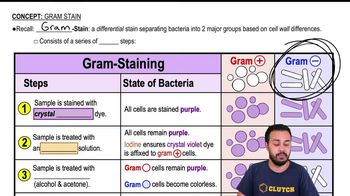
All bacterial cells, both Gram-positive and Gram-negative, are stained purple by crystal violet.
What general type of stain is used to separate types of bacteria based on their cellular structures?
A differential stain, such as the Gram stain, is used to separate bacteria based on cell wall structure.
Why must fresh cells be used when performing a Gram stain?
Fresh cells are needed because older cells may have damaged cell walls, leading to inaccurate Gram stain results.
How is the Gram-staining procedure best described?
A differential staining technique that distinguishes Gram-positive from Gram-negative bacteria.
How will E. coli appear in a Gram stain if the mordant is not applied?
E. coli will likely lose the crystal violet dye during decolorization and appear pink after counterstaining.
Which of these is not part of the Gram stain procedure?
Applying methylene blue is not part of the Gram stain procedure.
What is the correct sequence of the Gram stain procedure?
Crystal violet, iodine, decolorizer (alcohol or acetone), Safranin.
Why must fresh cells be used when performing a Gram stain?
Fresh cells ensure accurate results because old or damaged cells may not retain the stain properly.
What reagents are included when performing a Gram stain?
Crystal violet, iodine, decolorizer (alcohol or acetone), and Safranin.
In a completed Gram stain, are Gram-negative bacteria colorless?
No, in a completed Gram stain, Gram-negative bacteria appear pink due to the Safranin counterstain.
The Gram stain and the endospore stain both use what type of staining technique?
Both use differential staining techniques to distinguish between different types of cells or structures.
The _____ stain provides critical information about the peptidoglycan structure of the cell wall.
Gram stain
In a completed Gram stain, how do Gram-positive bacteria appear?
Gram-positive bacteria appear purple.
In the Gram stain, crystal violet is the __________.
Primary stain
How would Bacillus cereus appear in a negative stain?
In a negative stain, Bacillus cereus cells would appear clear against a dark background.
After Gram's iodine is added, what color do the cells appear under a light microscope?
All cells appear purple after iodine is added.
_____ stains Gram-negative bacteria pink.
Safranin
The technique developed by Hans Christian Gram is important for bacterial what?
Classification and identification based on cell wall structure.
Is the counterstain used in the Gram stain a basic dye?
Yes, Safranin, the counterstain in the Gram stain, is a basic dye.
What is the appearance of Gram-positive bacteria after addition of the first dye in the Gram stain?
Gram-positive bacteria appear purple after the first dye (crystal violet) is added.
What do the Gram stain, acid-fast stain, and endospore stain have in common?
They are all differential stains used to distinguish different types of bacteria or structures.
What factors should be considered if a Gram stain result is unclear?
Consider the age of the culture, staining technique, and quality of reagents.
In the Gram stain, what is the purpose of the decolorizer?
The decolorizer removes crystal violet from Gram-negative cells, making them colorless before counterstaining.
Which is the correct order of the four reagents of the Gram stain?
Crystal violet, iodine, decolorizer, Safranin.
The proper sequence of reagents in the Gram stain procedure is?
Crystal violet, iodine, decolorizer, Safranin.
What is the order of reagents in the Gram stain reaction?
 Back
Back
 04:57
04:57