Back

Group Translocation quiz

Control buttons has been changed to "navigation" mode.
1/15
  • What is group translocation in bacteria?

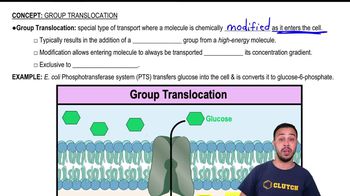
    Group translocation is a transport process where a molecule is chemically modified as it crosses the membrane into the cell.
  • What typically happens to a molecule during group translocation?

    The molecule is usually modified by the addition of a phosphate group from a high-energy molecule.
  • Which organism group is group translocation exclusive to?

    Group translocation is exclusive to bacteria.
  • What is the main energy source used in group translocation?

    A high-energy molecule provides the phosphate group needed for the chemical modification.
  • How does group translocation allow continuous uptake of a molecule like glucose?

    By modifying glucose to glucose-6-phosphate, the cell maintains a higher external glucose concentration, allowing continuous uptake.
  • What is the specific example of group translocation in E. coli called?

    It is called the phosphotransferase system (PTS).
  • What happens to glucose as it enters an E. coli cell via group translocation?

    Glucose is converted into glucose-6-phosphate as it is transported into the cell.
  • Why do glucose and glucose-6-phosphate have different concentration gradients?

    Because they are chemically different, each has its own gradient across the membrane.
  • Why is group translocation sometimes considered a type of active transport?

    Because it requires energy from a high-energy molecule to chemically modify the transported molecule.
  • What is the main benefit of chemically modifying a molecule during transport?

    It allows the cell to keep importing the original molecule down its concentration gradient.
  • Where is the phosphate group added on glucose during group translocation?

    The phosphate group is added to the 6th carbon of glucose, forming glucose-6-phosphate.
  • What role does the transporter protein play in group translocation?

    The transporter protein facilitates the movement and chemical modification of the molecule as it enters the cell.
  • How does group translocation differ from simple diffusion?

    In group translocation, the molecule is chemically modified and energy is used, unlike simple diffusion.
  • What is the fate of the high-energy molecule used in group translocation?

    It donates a phosphate group to the incoming molecule, becoming dephosphorylated.
  • Why can the cell continuously import glucose using group translocation?

    Because glucose is converted to glucose-6-phosphate inside the cell, the internal glucose concentration remains low, maintaining the gradient.